




What's Happening?
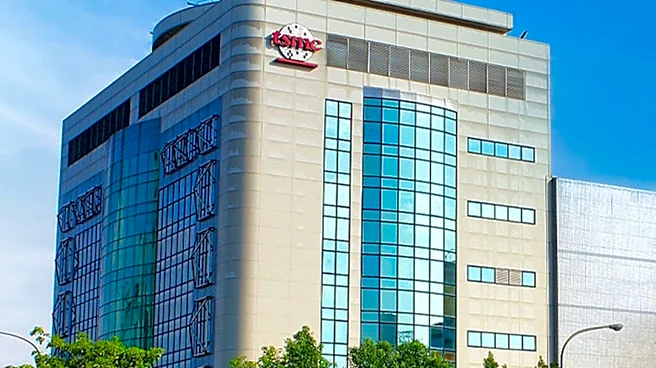
Taiwan Semiconductor Manufacturing Company (TSMC) is expected to be one of the few companies capable of navigating the newer version of AI restrictions imposed on China. The company's revenue generated from its China capacity is relatively small, with
Nanjing contributing approximately 2.4% of TSMC’s total revenue. Combined, all of TSMC's fabs in China account for roughly 2-3% of its total revenue. This low percentage is attributed to the fact that the equipment in these facilities is fully depreciated, making them profitable despite the smaller revenue contribution. While China customers represent about 9% of TSMC's total revenue, the actual manufacturing capacity within China is significantly less, primarily located in Shanghai (Fab 10, 8-inch) and Nanjing (Fab 16, 12-inch, producing 16/12nm and 28/22nm wafers at approximately 60k wafers/month). Nanjing's capacity alone accounts for about 3% of TSMC's total global capacity.
Why It's Important?
This situation highlights the strategic positioning of TSMC in the global semiconductor industry, particularly concerning U.S. and international AI restrictions targeting China. The ability of TSMC to continue operations in China with minimal financial disruption, despite new AI-related limitations, suggests a nuanced impact of these policies. For U.S. policymakers, this indicates that while restrictions aim to curb China's AI advancements, companies like TSMC, with diversified global operations and specific operational structures, may find ways to mitigate the direct financial consequences. This could influence future policy decisions regarding the scope and enforcement of technology export controls. For the semiconductor industry, it underscores the importance of geographical diversification and the long-term investment cycles in manufacturing facilities, where fully depreciated assets can offer a buffer against geopolitical shifts. Companies with significant exposure to the Chinese market in terms of manufacturing capacity might face greater challenges, whereas TSMC's model appears more resilient.
What's Next?
The ongoing implementation and potential tightening of AI restrictions on China will continue to be a critical factor for semiconductor manufacturers. TSMC will likely continue to monitor the evolving regulatory landscape and adjust its operational strategies to remain compliant while minimizing business impact. Other semiconductor companies with more substantial manufacturing footprints or customer bases in China may need to re-evaluate their strategies, potentially leading to shifts in global supply chains. The U.S. government may assess the effectiveness of current restrictions and consider further measures if the intended impact on China's AI development is not achieved. This could involve more granular controls on specific technologies or a broader definition of what constitutes 'AI-related' manufacturing. The long-term implications could include a further decoupling of technology supply chains between the U.S. and China, pushing companies to choose sides or develop distinct product lines for different markets.
Beyond the Headlines
The resilience of TSMC in the face of AI restrictions points to a broader trend in global manufacturing where established players with advanced technology and diversified operations can adapt to geopolitical pressures. This scenario also raises questions about the efficacy of broad-stroke sanctions in a highly interconnected global economy. It suggests that while restrictions can create hurdles, they may also inadvertently incentivize companies to optimize their existing assets and find loopholes or alternative strategies. The focus on 'fully depreciated equipment' highlights an economic reality: older, less advanced technology, while still profitable, may fall outside the scope of cutting-edge restrictions, allowing for continued, albeit limited, engagement. This could lead to a two-tiered technology ecosystem, where advanced technologies are tightly controlled, while older generations remain accessible, potentially slowing but not entirely halting technological progress in restricted regions.