






What's Happening?
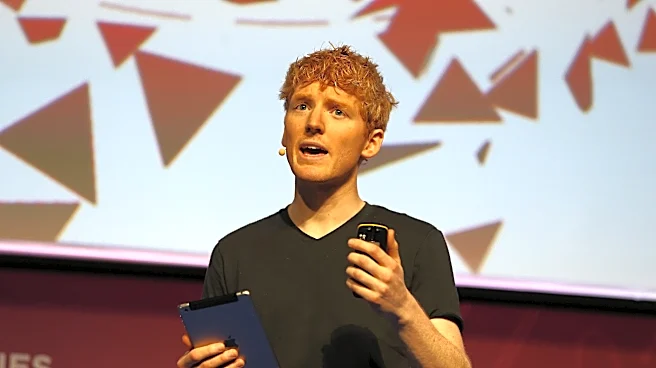
Patrick Collison, CEO of Stripe, advocates for rapid development and efficiency in project execution, drawing parallels to historical feats of fast construction like the Empire State Building. Collison maintains a blog featuring a page titled 'Fast,'
which compiles examples of ambitious projects completed quickly. This initiative aims to inspire and demonstrate that many undertakings can be achieved in significantly shorter timeframes than typically assumed. The philosophy behind 'Fast' challenges the notion that complex projects inherently require extended periods, suggesting that perceived timelines are often influenced by path dependence and Parkinson's Law. Collison's perspective highlights that by setting aggressive deadlines and focusing on essential elements, teams can achieve remarkable speed without compromising quality, often leading to more iterations and ultimately superior outcomes. This approach encourages breaking down traditional barriers and questioning established timelines in various industries.
Why It's Important?
Collison's emphasis on speed and efficiency holds significant implications for U.S. businesses and startups. In a competitive landscape, the ability to rapidly develop and iterate products can be a decisive factor in market success. His 'Fast' philosophy challenges conventional project management, which often prioritizes extensive planning over quick execution and learning. By demonstrating that major projects can be completed in record time, Collison encourages a shift in mindset that could lead to increased innovation and responsiveness across industries. Startups, in particular, stand to gain by adopting these principles, as faster iteration cycles can help them validate ideas, pivot quickly, and gain market share more effectively. This approach could also influence venture capital funding decisions, favoring companies that demonstrate a capacity for rapid development and efficient resource utilization, thereby reshaping investment strategies and entrepreneurial ecosystems.
What's Next?
The continued promotion of rapid development methodologies by influential figures like Patrick Collison is likely to inspire more companies to re-evaluate their project timelines and operational strategies. We may see an increased adoption of 'sprint' methodologies and aggressive deadline setting in various sectors, pushing teams to innovate under tighter constraints. This could lead to a cultural shift where speed is not just a desirable trait but a core competency for businesses aiming for market leadership. Furthermore, educational and training programs for entrepreneurs and project managers might begin to incorporate these principles more explicitly, focusing on how to achieve ambitious goals in compressed timeframes. The success stories highlighted by Collison could serve as case studies, encouraging a broader movement towards challenging conventional timelines and fostering a more agile and efficient business environment.
Beyond the Headlines
The 'Fast' philosophy extends beyond mere project management; it touches upon deeper psychological and cultural aspects of work. Collison's ideas implicitly critique the ingrained habits of organizations that often lead to procrastination and inefficiency, such as path dependence—where processes are followed simply because they always have been—and Parkinson's Law, where work expands to fill the time allotted. By advocating for speed, Collison is also promoting a culture of decisiveness, risk-taking, and continuous learning. This approach challenges the fear of failure that often paralyzes teams, suggesting that rapid iteration allows for quicker identification and correction of mistakes, ultimately leading to better outcomes. The long-term implication could be a redefinition of 'quality' in development, where quality is not just about perfection at launch but about the ability to quickly adapt and improve based on real-world feedback, fostering a more dynamic and resilient business ecosystem.