



What's Happening?
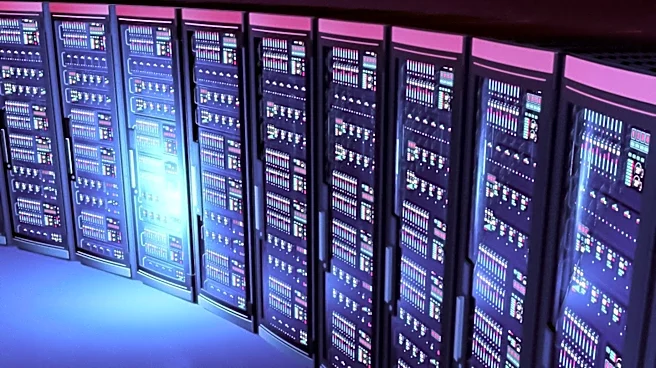
A new study by economist Stijn Van Nieuwerburgh, published by the Brookings Institution, projects that total investment in artificial intelligence (AI) infrastructure, including data centers, will reach an unprecedented $10.3 trillion between 2025 and
2032. This figure represents an annual average equivalent to 3.6% of U.S. GDP, positioning it as the largest infrastructure investment cycle in U.S. history relative to the size of the economy. This surpasses previous major buildouts such as canals, railroads, and electrification. Goldman Sachs estimates that U.S. AI investment will account for 1.9% of GDP in 2026. The report highlights that this massive investment is reshaping the U.S. economy, creating hundreds of thousands of jobs and contributing to a surge in stock market wealth. However, it also points out potential risks associated with this growing dependence on AI infrastructure, particularly if demand slows or investments fail to generate sufficient returns.
Why It's Important?
This projected investment signifies a monumental shift in the U.S. economic landscape, with profound implications for various sectors. The scale of the buildout is creating significant job growth, with LinkedIn estimating over 750,000 AI-related jobs created in the U.S. between 2023 and 2026, often with high median salaries of around $180,000. This influx of high-paying jobs can boost economic activity and innovation. However, the study also warns of potential systemic financial risks due to the concentration of spending among a few hyperscaler technology companies like Microsoft, Meta, Alphabet, Oracle, and Amazon. These companies are projected to spend $4.2 trillion by the end of 2029, increasingly financed through debt. If AI fails to generate enough revenue to support this debt, the effects could extend beyond the technology sector into the broader financial system, potentially leading to correlated losses across companies and financial institutions. Additionally, the demand for resources like electricity and skilled labor for data center construction is straining supplies, potentially raising costs for other businesses and impacting housing affordability.
What's Next?
The trajectory of AI infrastructure investment suggests continued rapid expansion, with ongoing job creation in both technology and skilled trades. However, the financial system will need to closely monitor the debt financing structures used by hyperscalers, including off-balance-sheet entities, private credit, and securitizations, to mitigate potential systemic risks. Regulators and financial institutions may need to develop new frameworks to assess and manage these complex exposures. Furthermore, the increasing demand for electricity and labor will necessitate strategic planning and investment in energy infrastructure and workforce development to avoid bottlenecks and cost escalations. Communities hosting data centers will likely experience both economic benefits and challenges related to resource strain. The long-term success of this investment cycle hinges on AI's ability to generate sufficient revenue and value to justify the massive capital outlay, and the ability of the broader economy to adapt to these significant structural changes.
Beyond the Headlines
The unprecedented scale of AI infrastructure investment raises deeper questions about economic sustainability, resource allocation, and the future of work. The concentration of power and investment in a few large technology companies could lead to increased market dominance and potential anti-competitive concerns. The environmental impact of massive data centers, particularly their energy consumption, will become an increasingly critical issue, requiring innovative solutions for sustainable power and cooling. Ethically, the rapid advancement and deployment of AI, fueled by this infrastructure, will necessitate ongoing discussions about data privacy, algorithmic bias, and the societal implications of increasingly intelligent systems. The shift in the labor market, with a demand for highly skilled AI professionals and skilled trades for construction, while beneficial in some areas, could also exacerbate existing inequalities if access to education and training for these new roles is not widely available. This investment cycle is not just about technology; it's about fundamentally reshaping the economic, social, and environmental fabric of the nation.