



What's Happening?
Belkin has launched its first power banks featuring semi-solid-state battery technology, branded as BoostSolid Cell. This new technology incorporates a gel-like layer alongside the traditional liquid electrolyte found in lithium-ion batteries. The company
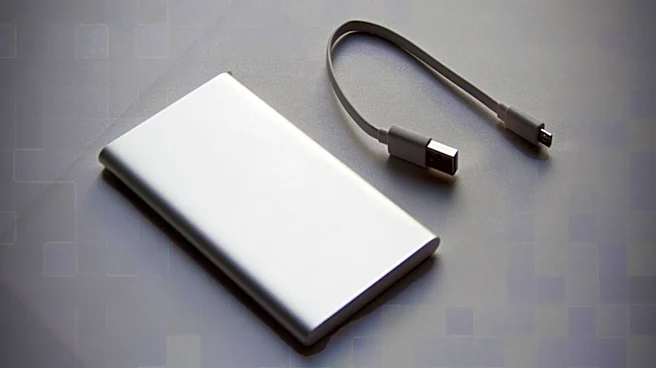
claims these new accessories are engineered to last up to three times longer than other power banks, maintaining up to 80% capacity after 1,000 charge cycles. Key advantages highlighted by Belkin include a reduced risk of overheating, swelling, or fires, and consistent power delivery across a wider temperature range (0 to 40 degrees Celsius). The UltraCharge Pro Slim Magnetic Power Bank 5K Qi2 15W, priced at $69.99, is 40% slimmer than comparable 5,000mAh power banks and offers 15W wireless charging and 22.5W via USB-C. The larger UltraCharge Pro Power Bank 10K 60W, costing $89.99, provides 10,000mAh capacity and up to 60W power delivery through dual USB-C ports and a USB-A port, along with a display showing charge level, power output, and internal temperature. These products are set to be available in September.
Why It's Important?
The introduction of semi-solid-state battery technology in consumer electronics like power banks is a significant development for the U.S. market. This innovation addresses critical consumer concerns regarding battery safety and longevity, which have historically been points of contention with traditional lithium-ion batteries. The reduced risk of overheating and fire, coupled with a longer functional lifespan, could lead to increased consumer confidence and a shift in purchasing preferences towards more durable and safer portable charging solutions. For the electronics industry, Belkin's move could set a new standard for power bank design and performance, potentially spurring other manufacturers to adopt similar semi-solid-state technologies. This could also influence regulatory bodies to update safety standards, as Belkin's products already meet the UL2056:2025 safety standard and TSA carry-on guidance, making them more appealing for travel. The higher price point for these advanced power banks suggests a premium market segment, but the promise of extended durability and enhanced safety could justify the investment for many users, ultimately impacting market competition and product development cycles.
What's Next?
Following Belkin's launch, the market will likely observe consumer adoption rates and competitor responses. If these semi-solid-state power banks gain traction, other electronics manufacturers may accelerate their research and development into similar battery technologies, potentially leading to a broader industry shift. Consumers can expect to see more options for safer and longer-lasting portable power solutions in the coming years. Belkin's success with these products could also pave the way for the application of semi-solid-state batteries in other small electronic devices, such as smartphones and wearables, before the technology becomes viable for larger applications like electric vehicles. The company's emphasis on meeting safety standards like UL2056:2025 and TSA guidelines suggests a proactive approach to regulatory compliance, which could become a benchmark for future product releases in the portable power sector. The availability of these power banks in September will be a key indicator of initial market reception.
Beyond the Headlines
The broader implications of Belkin's semi-solid-state power banks extend beyond mere product features. This development highlights a crucial trend in battery technology where advancements are first commercialized in smaller, less complex devices before scaling up to larger applications. While the automotive industry still views solid-state batteries for electric vehicles as a decade away, the successful integration of semi-solid-state technology in consumer accessories demonstrates a viable pathway for innovation. This incremental approach allows for real-world testing and refinement of new battery chemistries in a controlled environment, mitigating risks associated with larger-scale deployment. Furthermore, the focus on enhanced safety and longevity addresses growing environmental concerns by potentially reducing electronic waste due to more durable products. This could contribute to a more sustainable consumption model in the long term, influencing consumer expectations for product lifespan and reliability across various electronic categories. The dual certification for Apple Find My and Google Find Hub in Belkin's new trackers also signifies a move towards greater interoperability in the tech ecosystem, benefiting users with mixed-device households.