





What's Happening?
Axelera AI, a European AI semiconductor company, has introduced its third-generation silicon architecture named Titania. This new architecture is designed to deliver high-performance AI acceleration for data centers, offering interactive speeds and energy
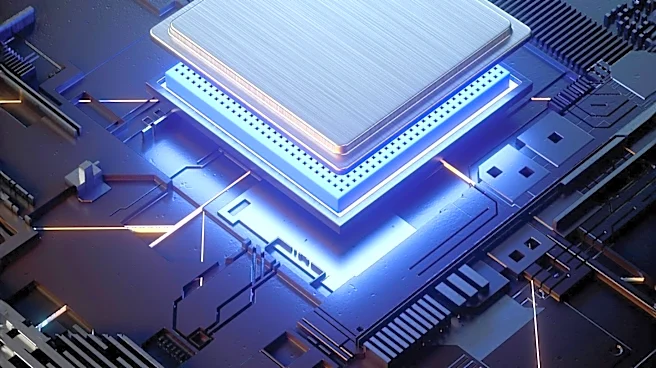
efficiency within the power and cooling limits of existing data center infrastructure. Titania aims to provide performance comparable to data center-grade servers at a significantly lower cost and power budget, avoiding the need for 100-kilowatt-plus liquid-cooled racks typically required by high-density GPU systems. The architecture builds on its predecessors, Metis and Europa, expanding its application from embedded and edge AI to large-scale data center inference. Titania combines Axelera AI's Digital In-Memory Computing (D-IMC) architecture with a chiplet-based design, high-capacity LPDDR6 memory, and high-bandwidth scale-up connectivity.
Why It's Important?
The introduction of Axelera AI's Titania architecture is significant for the U.S. technology and business sectors, particularly for enterprises, sovereign clouds, and telecommunications companies. It addresses a critical challenge in AI infrastructure: the high capital expenditure and operational costs associated with deploying and maintaining powerful AI systems. By offering HPC-class AI responsiveness without requiring specialized liquid-cooled racks, Titania makes advanced AI inference more accessible and affordable for a broader range of organizations. This could democratize access to high-performance AI, allowing more companies to leverage large language models and other complex AI workloads within their existing data center footprints. The focus on energy efficiency and cost-effectiveness could also drive innovation in AI hardware development and reduce the environmental impact of large-scale AI deployments.
What's Next?
Titania is scheduled to go into production in Q3 2027, with customer deployment commitments already secured through early 2028. Axelera AI plans to offer Titania in various form factors, including industry-standard PCIe cards and OCP-compliant boards, enabling flexible integration into existing server infrastructures. OEM and ODM partners will be instrumental in building this technology into servers and larger systems. The company will provide a more in-depth technical overview of the Titania architecture at SC26 in Chicago, IL. The continued development and deployment of Titania could lead to a shift in how enterprises approach their AI infrastructure, potentially reducing the reliance on extremely high-cost, specialized hardware and fostering a more distributed and efficient AI ecosystem.
Beyond the Headlines
The development of architectures like Titania points to a broader trend in the AI industry: the push for more efficient and accessible AI computing. This could have profound implications for the competitive landscape, potentially enabling smaller players to compete with tech giants in AI development and deployment. The emphasis on using readily available LPDDR6 memory instead of scarce high-bandwidth memory (HBM) also highlights a strategic move to mitigate supply chain dependencies and reduce overall system costs. This could lead to a more resilient and diverse AI hardware market. Furthermore, the ability to run large AI models within existing power and cooling environments could accelerate the adoption of AI across various industries, leading to new applications and services that were previously cost-prohibitive.