







What's Happening?
A recent analysis clarifies the distinctions between neon art and blacklight art, addressing common public confusion. Neon art involves glass tubes bent into shapes, filled with noble gases, and illuminated by high voltage electricity, making the artwork
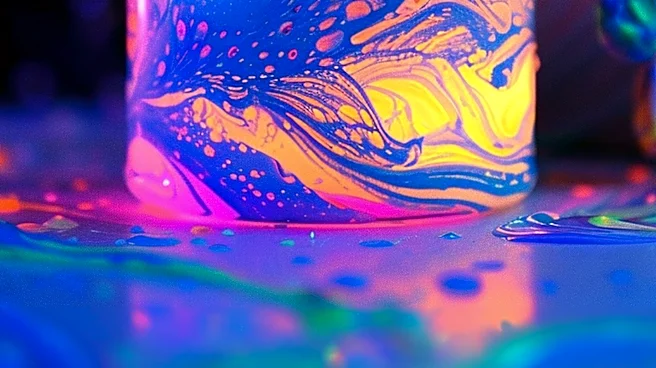
itself the light source. These pieces glow independently once powered, regardless of ambient light. In contrast, blacklight art utilizes fluorescent pigments that absorb invisible ultraviolet (UV-A) energy and re-emit it as visible light. This means blacklight art requires an external UV-A lamp to glow and appears ordinary in regular lighting conditions. The term 'neon' is often colloquially used to describe any bright, saturated color, further contributing to the misunderstanding between these two distinct artistic mediums. The practical difference lies in their light source: neon art generates its own light, while blacklight art reacts to an external UV light source.
Why It's Important?
Understanding the fundamental differences between neon and blacklight art is crucial for artists, collectors, and consumers. For artists, this distinction impacts material selection, installation requirements, and the intended visual effect of their work. Collectors need to be aware of these differences for proper display, maintenance, and safety considerations, as neon art involves fragile glass and high voltage, requiring specialized handling for installation and repair. For consumers, clarity helps in making informed purchasing decisions, ensuring they acquire the type of glowing art that meets their expectations for display environment and aesthetic. The misapplication of the term 'neon' to describe fluorescent colors can lead to disappointment if a buyer expects a self-illuminating piece but receives one that requires a specific UV light setup. This clarification helps in appreciating the unique properties and artistic potential of each medium.
What's Next?
As awareness grows regarding the technical differences between neon and blacklight art, it is anticipated that artists may further explore the unique properties of each medium to create more distinct and innovative works. Educational efforts, such as detailed product descriptions and informational guides from galleries and art suppliers, are likely to become more prevalent to help consumers make informed choices. The market may see a clearer segmentation of these art forms, potentially leading to specialized exhibitions or retail spaces. Furthermore, advancements in lighting technology, particularly in UV-A lamps, could enhance the visual impact and accessibility of blacklight art, while innovations in glass and gas technology might offer new possibilities for neon artists. The ongoing clarification will likely foster a more discerning appreciation for both art forms.
Beyond the Headlines
The confusion between neon and blacklight art highlights a broader trend in language where technical terms become generalized for aesthetic descriptions. 'Neon' has evolved from a specific gas used in lighting to a descriptor for any vivid, intense color. This linguistic shift can obscure the underlying scientific and artistic processes, potentially diminishing the appreciation for the craftsmanship and technology involved in true neon art. Ethically, mislabeling can mislead consumers, creating a gap between expectation and reality. Legally, clearer distinctions could become important in intellectual property and consumer protection, especially as these art forms gain popularity. Culturally, the distinct visual impacts of self-illuminating neon versus UV-reactive blacklight art offer different experiential qualities, influencing how spaces are designed and how audiences interact with light and color in art.