






What's Happening?
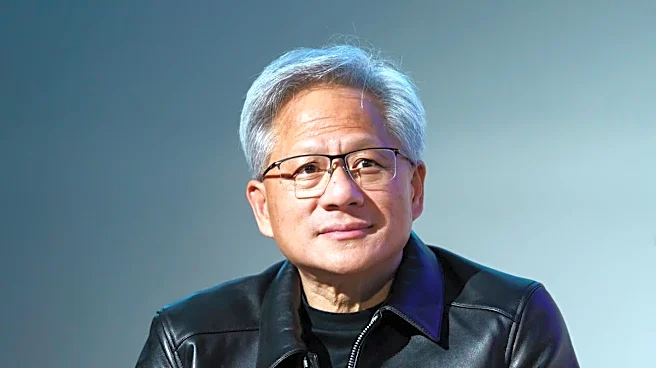
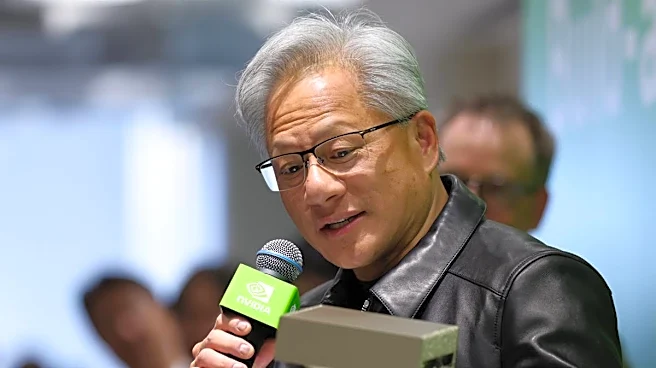
Nvidia Corp. CEO Jensen Huang has strongly supported the massive expansion of data centers across the U.S., asserting that the AI boom is actively 'reindustrializing' America. This statement comes after decades of manufacturing moving overseas. Huang's
comments were made in response to investor Gavin Baker, who revised his earlier criticisms of data centers, noting that concerns regarding their impact on water, electricity prices, taxes, jobs, and local communities have eased as projects have evolved. Huang emphasized that AI is driving manufacturing back to the U.S. and creating significant construction and manufacturing jobs across energy plants, chip fabs, and data centers. He also highlighted that the AI boom is fostering new companies and industries, with an estimated $400 billion invested in AI startups in the past six months alone.
Why It's Important?
Jensen Huang's advocacy for AI data center expansion and his assertion that AI is 'reindustrializing' America carry significant implications for the U.S. economy and workforce. The emphasis on bringing manufacturing back to the U.S. directly addresses long-standing concerns about offshoring and job losses in traditional industries. The creation of construction and manufacturing jobs in energy plants, chip fabs, and data centers represents a tangible economic benefit, providing employment opportunities in various skilled trades. Furthermore, the reported $400 billion investment in AI startups signifies a robust and growing innovation ecosystem, potentially leading to new industries and technological advancements. This shift could reshape regional economies, particularly in areas where data centers and related infrastructure are being developed, offering substantial property tax revenues and local infrastructure improvements, as seen in Loudoun County, Virginia, and Quincy, Washington.
What's Next?
The continued expansion of AI data centers, as championed by Jensen Huang, is expected to drive further investment in America's aging power grid and sustainable energy infrastructure, primarily through market forces rather than subsidies. This will likely lead to more construction and manufacturing jobs in these sectors. However, the data center boom is also facing increasing grassroots pushback from communities concerned about power demand, water usage, noise, pollution, and pressure on local infrastructure. This pushback, exemplified by actions in Michigan and Texas, indicates that future data center projects will need to prioritize community engagement and demonstrate clear local benefits to gain acceptance. Major tech companies, including Microsoft, Google, Amazon, Meta, and OpenAI, will likely face continued pressure to address these concerns while still meeting the surging demand for AI infrastructure.
Beyond the Headlines
The debate surrounding AI data center expansion, as framed by Jensen Huang, touches upon deeper societal and environmental considerations. While Huang highlights the economic benefits and job creation, the grassroots pushback reveals a tension between technological advancement and local community impact. The need for significant investments in the power grid and sustainable energy infrastructure, driven by AI, underscores the broader challenge of balancing energy demands with environmental sustainability. This situation could lead to innovative solutions in energy efficiency and renewable energy integration for data centers. Moreover, the discussion about 'reindustrializing' America through AI suggests a potential paradigm shift in national economic strategy, where advanced technology, rather than traditional heavy industry, becomes the new engine for domestic manufacturing and job growth, prompting a re-evaluation of industrial policy and workforce development.