





What's Happening?
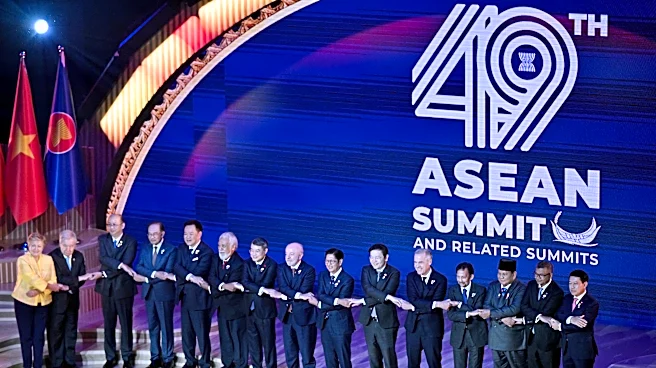
The Association of Southeast Asian Nations (ASEAN) leaders have adopted a new Critical Minerals Strategy during the 49th ASEAN Summit in Manila. This strategy aims to enhance the region's role in the global critical minerals supply chain by attracting
more investments and expanding production capabilities. The declaration emphasizes the need for secure, resilient, diversified, and sustainable critical mineral supply chains to support industrial development, the global energy transition, digital transformation, and emerging technologies. ASEAN plans to identify priority regional value chains, mobilize responsible public and private investments, and foster cooperation in research, technology transfer, and human capital development. The strategy also commits to advancing circular economy approaches through efficient resource use and recycling. Concurrently, civil society coalitions are urging ASEAN leaders to implement legally binding human rights and environmental safeguards in mining operations, warning that surging demand for critical minerals threatens communities without strict protections.
Why It's Important?
This strategic move by ASEAN is significant for the global economy, particularly for industries reliant on critical minerals such as electric vehicles, renewable energy, and advanced electronics. Southeast Asia is a major supplier of nickel and holds substantial rare-earth reserves, making its regulatory shifts crucial for international resource investors. For the U.S., securing diversified and sustainable supply chains for critical minerals is a national security and economic priority, especially given efforts to reduce dependence on China. Initiatives like the proposed US-Philippines Pax Silica framework underscore this interest. The ASEAN strategy could offer new opportunities for U.S. companies to invest and collaborate, strengthening supply chain resilience. However, the push for human rights and environmental safeguards by civil society groups highlights potential ethical and operational challenges that international investors, including those from the U.S., will need to address to ensure responsible sourcing and avoid reputational risks.
What's Next?
The ASEAN Ministerial Meeting on Minerals is tasked with developing and implementing the regional strategy, including priority actions, investment opportunities, and measurable outcomes. This will involve detailed planning and coordination among member states to identify specific projects and attract investment. Civil society groups will likely continue to pressure ASEAN governments to embed enforceable human rights standards, corporate accountability, and environmental protections directly into the strategy. This could lead to increased scrutiny of mining projects and potential delays if safeguards are not adequately addressed. For the U.S., future engagement will likely involve bilateral discussions and potential partnerships under frameworks like Pax Silica, focusing on securing supply chains while promoting responsible mining practices. The success of the strategy will depend on effective implementation and the ability to balance economic development with social and environmental responsibilities.
Beyond the Headlines
The ASEAN Critical Minerals Strategy reflects a broader global trend of nations asserting greater control over their natural resources and supply chains in an era of increasing geopolitical competition and energy transition. This move could reshape global mineral trade flows and investment patterns, potentially leading to new regional power dynamics in the resource sector. The emphasis on sustainability and human rights, driven by civil society, signals a growing awareness that the pursuit of critical minerals cannot come at the expense of local communities and the environment. This creates a complex ethical landscape for multinational corporations and governments, pushing for more transparent and equitable benefit-sharing mechanisms. Ultimately, the success of ASEAN's strategy will not only be measured by economic growth but also by its ability to foster a model of resource development that is both competitive and socially responsible, setting a precedent for other resource-rich regions.