



What's Happening?
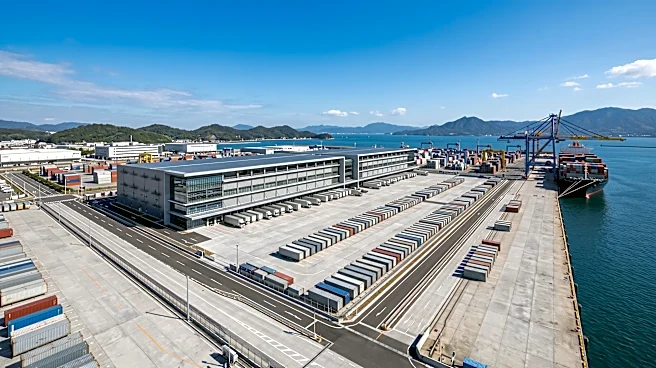
Mazda Motor Corporation has announced the completion of its new logistics center, the Mazda KD Center, located at Hiroshima Port in Japan. The facility, which held its completion ceremony on November 6, is scheduled to commence operations in January 2027.
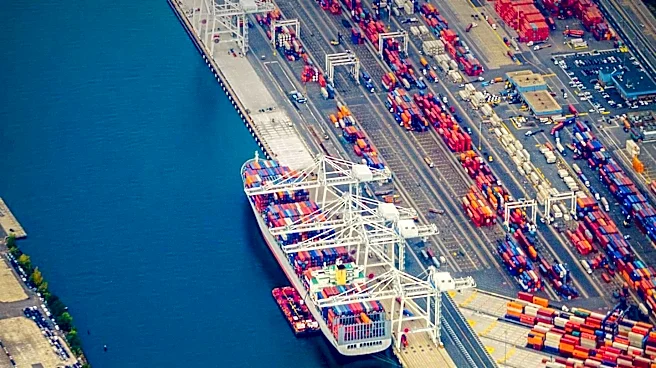
This new center is designed to support Mazda's vehicle production facilities outside of Japan by handling knockdown (KD) parts, which are shipped to overseas factories for vehicle assembly. The new center replaces an older facility in the Kaita district of Hiroshima Port and offers improved access to the port's international container terminal, which has been upgraded to accommodate larger cargo vessels. Construction of the 55,000-square-meter facility began in April 2025, with the main building covering approximately 35,000 square meters. Mazda Logistics Co. Ltd. will be responsible for operating the new center.
Why It's Important?
This new logistics center is a significant development for Mazda's global supply chain and manufacturing efficiency. By enhancing the flow of KD parts to its international assembly plants, Mazda aims to strengthen the connection between its Japanese operations and overseas production sites. The increased use of automation for storing, retrieving, and preparing parts for shipment is expected to reduce manual handling, improve processing efficiency, and potentially lower operational costs. Furthermore, the facility's strategic location at Hiroshima Port, with its improved container terminal, will allow Mazda to leverage better infrastructure for international shipments. This investment underscores Mazda's commitment to optimizing its global manufacturing network and ensuring the timely delivery of components, which directly impacts the quality of vehicles delivered to customers worldwide.
What's Next?
Operations at the Mazda KD Center are set to begin in January 2027. Following its activation, Mazda expects to see improvements in its global parts supply network, leading to more efficient vehicle assembly processes at its overseas factories. The company anticipates reduced unloading times for truck drivers delivering components due to simplified entry procedures and dedicated forklift operators. The facility's rooftop solar panels, with a generation capacity of 2.2 megawatts, will contribute to its power requirements, aligning with broader sustainability goals. Mazda will likely monitor the center's performance to assess the impact of automation and improved logistics on its overall production efficiency and supply chain resilience.
Beyond the Headlines
The completion of the Mazda KD Center reflects a broader trend in the automotive industry towards optimizing global supply chains and leveraging advanced logistics. The emphasis on automation within the facility highlights a strategic move to enhance operational efficiency and reduce labor-intensive tasks, potentially setting new benchmarks for logistics in the automotive sector. The integration of solar panels also points to a growing corporate commitment to renewable energy and sustainability within manufacturing operations. This development could influence other automakers to invest in similar advanced logistics hubs, further streamlining international parts distribution and potentially impacting global trade dynamics for automotive components. The improved infrastructure at Hiroshima Port, supported by national and prefectural governments, also signifies the importance of robust port facilities in supporting international manufacturing and trade.