




What's Happening?
Applied Materials, a leader in materials engineering solutions for the semiconductor industry, has announced a partnership with KIOXIA Corporation, a global supplier of flash memory and solid-state drives (SSDs). This collaboration will take place at Applied Materials'
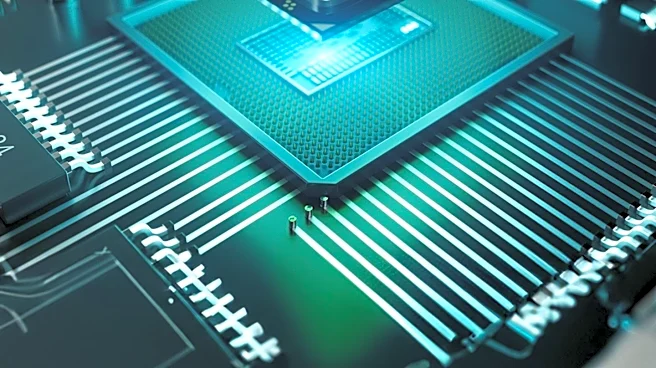
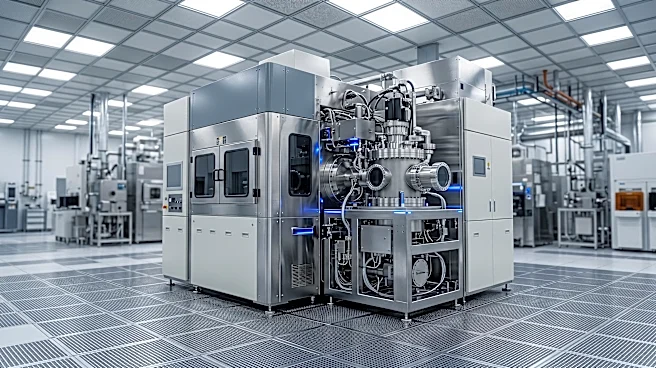
new $5 billion Equipment and Process Innovation and Commercialization (EPIC) Center in Silicon Valley. The focus of this partnership is to advance next-generation memory technologies crucial for artificial intelligence (AI) applications. The companies will work together on developing advanced memory-cell and structure creation, multi-chip stacking architectures, and new materials engineering approaches. The goal is to increase memory density and performance, which are critical requirements for the AI era. The EPIC Center, which is expected to be operationally ready this year, represents the largest U.S. investment in advanced semiconductor equipment R&D, aiming to significantly reduce the time required to commercialize breakthrough technologies from research to high-volume manufacturing.
Why It's Important?
This partnership is significant for the U.S. semiconductor industry and the broader technology landscape. The development of advanced memory solutions is a cornerstone for the continued progress of AI, which demands increasingly higher memory density, greater bandwidth, and improved energy efficiency. By collaborating at the EPIC Center, Applied Materials and KIOXIA are directly addressing these challenges, aiming to accelerate the commercialization of memory and packaging technologies that achieve new levels of integration and performance for AI computing. This initiative reinforces the U.S.'s position in semiconductor innovation and manufacturing, particularly in a sector vital for national economic competitiveness and technological leadership. The EPIC Center's role in fostering early-stage co-development with leading customers like KIOXIA is expected to improve revenue visibility and support more resilient margins for Applied Materials, while also strengthening the domestic supply chain for critical AI components.
What's Next?
Over the coming months, a key indicator of progress will be how quickly the projects initiated at the EPIC Center with KIOXIA transition from research and development into production tools and service contracts. Investors and industry observers will be closely monitoring disclosures regarding EPIC-related customer programs, particularly those detailing advancements in high-bandwidth memory, stacked architectures, or advanced packaging solutions linked to AI-oriented fabrication plants. The operational readiness of the EPIC Center this year will mark the beginning of these collaborative efforts. The success of this partnership could lead to further investments and collaborations within the semiconductor ecosystem, potentially attracting more companies to leverage the EPIC Center's capabilities for advanced R&D. The long-term impact will be measured by the tangible breakthroughs in memory technology and their adoption in AI infrastructure.
Beyond the Headlines
The collaboration between Applied Materials and KIOXIA at the EPIC Center highlights a deeper trend in the semiconductor industry: the increasing necessity for co-innovation and integrated development across the supply chain. As AI workloads become more complex, the traditional linear model of component development is giving way to more collaborative ecosystems where equipment manufacturers, memory producers, and chip designers work hand-in-hand from the earliest stages. This approach not only accelerates technological advancements but also mitigates risks associated with developing highly specialized components. Furthermore, the substantial investment in the EPIC Center underscores a strategic national effort to bolster domestic semiconductor R&D and manufacturing capabilities, reducing reliance on foreign supply chains and enhancing national security in critical technology sectors. This initiative could set a precedent for future public-private partnerships aimed at maintaining U.S. leadership in advanced technologies.