




What's Happening?
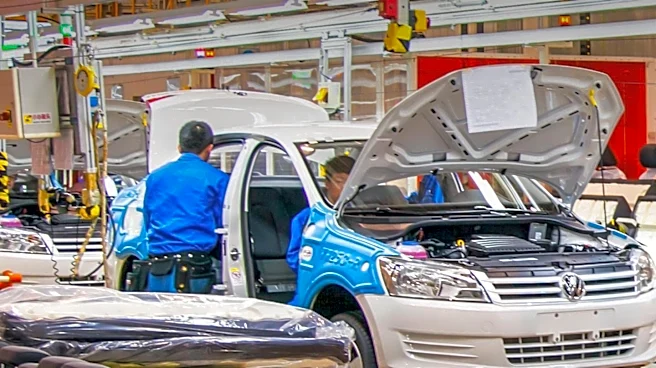
Volkswagen has launched its first industrial disassembly line at its Zwickau vehicle plant in Germany. This new operation will recover genuine OEM parts and raw materials from end-of-life vehicles, running concurrently with ongoing car production. Starting
in 2027, the eight-station line is projected to disassemble 4,100 vehicles annually in a two-shift operation, with plans to scale capacity to 15,000 vehicles per year by 2030. One hundred employees have been retrained for this new division. The equipment for the line was installed in nine months, ahead of schedule, and involved reusing existing manufacturing equipment where possible. Genuine used OEM parts recovered from this process have been distributed through dealers, repair shops, and parts retailers since July. Volkswagen is investing up to €90 million (approximately $101 million USD) in this initiative, with additional funding from Saxony.
Why It's Important?
This initiative by Volkswagen marks a significant step towards a circular economy in the automotive industry. By industrially disassembling vehicles and recovering parts and raw materials, Volkswagen aims to meet future EU recyclate quotas for plastics and other materials, which become effective from 2032. The ability to recover materials like plastic, with one end-of-life vehicle potentially supplying material for three new cars, highlights the economic and environmental benefits of this approach. This move reduces the reliance on virgin resources, lowers production costs, and minimizes waste, contributing to sustainability goals. The creation of a new division and the retraining of 100 employees also demonstrate a commitment to job creation and skill development within the green economy. This model could influence other major automotive manufacturers to adopt similar practices, driving a broader shift towards sustainable production and consumption in the industry.
What's Next?
Volkswagen plans to expand the disassembly capacity at the Zwickau plant to 15,000 vehicles annually by 2030. The company also intends to establish a European circular-economy partner network over the long term, indicating a broader strategy to integrate recycling and material recovery across its operations and supply chain. Data platforms and AI applications will be utilized to track and control material flows, optimizing the efficiency of the disassembly process. The new division is expected to employ up to 1,000 people as it scales up. This initiative will serve as a blueprint for how large-scale manufacturing can incorporate end-of-life product management into its core business model, responding to increasing regulatory pressures and consumer demand for sustainable products.
Beyond the Headlines
Volkswagen's industrial disassembly line represents a paradigm shift from a linear 'take-make-dispose' economy to a circular one within the automotive sector. This move has profound implications for resource management, supply chain resilience, and environmental impact. By extending the life cycle of components and materials, the company is not only reducing waste but also potentially mitigating the volatility of raw material prices and geopolitical risks associated with their extraction. The integration of AI and data platforms for material flow management signifies the increasing role of advanced technology in achieving sustainability goals. This initiative could also foster innovation in material science and manufacturing processes, leading to the development of more easily recyclable and reusable vehicle components. Ultimately, this model could redefine the value proposition of vehicles, moving towards a system where products are designed for longevity, repairability, and eventual material recovery.