





What's Happening?
Air India announced on November 15 the restoration of non-stop flight operations across all four routes connecting Delhi and Mumbai with New York and Newark. This move significantly reduces journey times by up to five hours, bringing the typical flight duration
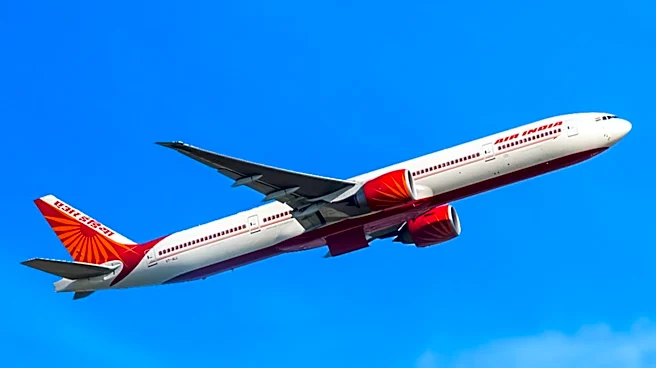
to approximately 17 hours. Previously, these long-haul flights included a technical refueling stop in Rome Fiumicino Airport (FCO), extending travel to around 22 hours. The airline attributed the earlier need for the Rome stop to the closure of Pakistan's airspace to Indian airlines and airspace restrictions in parts of the Middle East due to regional conflict. The restored non-stop routes include daily flights from Delhi and Mumbai to John F. Kennedy International Airport (JFK), four weekly flights between Delhi and Newark Liberty International Airport (EWR), and three weekly flights between Mumbai and Newark Liberty International Airport (EWR). Air India is deploying its Airbus A350-900 on Delhi-JFK and Delhi-Newark routes, and Boeing 777-300ER on Mumbai-JFK and Mumbai-Newark routes.
Why It's Important?
The restoration of non-stop flights by Air India to major U.S. hubs like New York and Newark is significant for travelers and the aviation industry. For passengers, the reduction in travel time by up to five hours offers a more convenient and efficient journey, potentially increasing demand for Air India's services on these routes. This improved connectivity can also foster stronger business and cultural ties between India and the U.S. by making travel less arduous. From an economic perspective, direct flights are often preferred by business travelers, which could lead to increased corporate travel and investment. The deployment of modern aircraft like the Airbus A350-900 and Boeing 777-300ER, featuring enhanced cabin configurations including Business Class suites and Premium Economy, aims to attract a broader range of passengers, including those seeking premium travel experiences. This competitive offering could influence other airlines operating on similar routes to enhance their services or adjust pricing.
What's Next?
With the non-stop operations fully restored, Air India will likely monitor passenger demand and operational efficiency on these routes. The airline may consider further expansion or adjustments to its U.S. network based on the success of these reinstated direct flights. Other airlines serving the India-U.S. corridor may respond to Air India's enhanced offering by evaluating their own flight schedules, aircraft deployments, and service amenities to remain competitive. Travelers can expect continued availability of tickets through Air India's website and travel agency partners. The improved travel times could also lead to an increase in tourism and business exchanges between the two countries, potentially impacting airport traffic and related services in New York and Newark.
Beyond the Headlines
The underlying reasons for the initial stopover—airspace restrictions due to regional conflicts—highlight the geopolitical sensitivities that can impact global aviation. While the immediate issue of the Rome stop has been resolved, the broader implications of such geopolitical factors on international travel routes remain a constant consideration for airlines. The ability of Air India to adapt its operations in response to these external challenges, first by introducing a technical stop and then by restoring direct flights, demonstrates the resilience and strategic planning required in the airline industry. This situation also underscores the importance of efficient air travel in facilitating global commerce and cultural exchange, as prolonged travel times can deter potential travelers and impact economic activities.