


What's Happening?
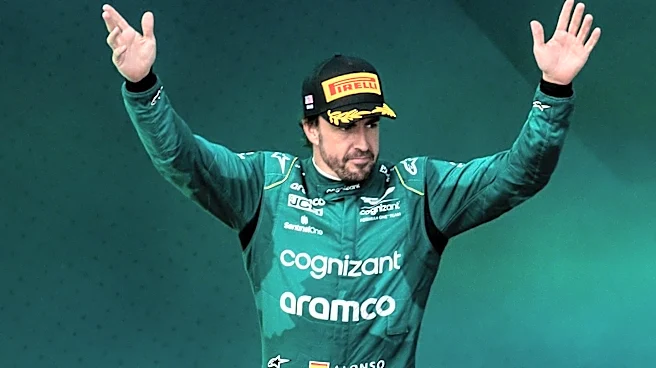
Fernando Alonso qualified 18th for the Dutch Grand Prix, a result that, despite being a Q1 exit, he views as indicative of significant progress for the Aston Martin AMR26 'B'. Alonso noted that his Q1 time was only 88 thousandths of a second from advancing
to Q2, and the gap to the leader was just over a second. He highlighted a substantial improvement in performance, stating that the team has gained three seconds in two races compared to previous gaps of 4-5 seconds to the front-runners. While acknowledging the team's advancements, Alonso pointed out a critical limitation: the inability to overtake on straights. He emphasized that while the car's handling has improved, further significant changes in physics or software are required, which he expects to originate from Japan. Alonso expressed cautious optimism for the race, believing the team's strong chassis could lead to better performance in race conditions, especially as tires wear.
Why It's Important?
This development is important for Aston Martin and Fernando Alonso as it signals a clear, albeit challenging, path forward in Formula 1. The reported three-second improvement in two races demonstrates that the team's development efforts are yielding tangible results, moving them closer to the competitive mid-field and potentially the top four teams. However, the persistent issue with straight-line speed and overtaking capability highlights a fundamental design or power unit limitation that could hinder their ability to convert qualifying improvements into race-day gains. This situation puts pressure on the team's technical departments and power unit supplier, Honda, to deliver substantial upgrades. For Alonso, a seasoned driver, his ability to extract maximum performance despite car limitations underscores his value, but also emphasizes the need for the team to provide a more complete package to consistently compete for higher positions. The team's performance trajectory will be closely watched as they aim to optimize their package for upcoming races like Monza.
What's Next?
Looking ahead, Aston Martin will focus on optimizing their current package for the Dutch Grand Prix race, leveraging their strong chassis for better race pace, particularly as tire degradation becomes a factor. Alonso anticipates that the team's performance typically improves in race conditions due to the chassis's grip. Beyond this race, the team expects significant upgrades, particularly in software and physics, to come from Japan, with a target for further improvements around the Monza race. This suggests a continued development push from Honda and the wider Aston Martin technical structure to address the power unit and drivability issues. The team will also be analyzing data from the current weekend to find the best configuration for future qualifying sessions and races. The goal is to build on the recent Q2 appearance in Hungary and consistently qualify in a stronger position.
Beyond the Headlines
The situation with Aston Martin and Fernando Alonso extends beyond immediate race results, touching upon the intricate dynamics of Formula 1 development and strategic partnerships. Alonso's direct call for 'big changes in the factory or software' coming from Japan can be interpreted as a clear message to Honda, their power unit supplier, to accelerate improvements. This highlights the critical interdependence between chassis designers and engine manufacturers in modern F1. The challenge of improving straight-line speed without compromising cornering ability is a complex engineering feat, often requiring significant investment in research and development. Furthermore, Alonso's ability to extract performance despite these limitations underscores the enduring value of driver skill in a sport increasingly dominated by technological prowess. The team's journey reflects the constant battle in F1 to balance incremental gains with the need for breakthrough innovations to climb the competitive ladder, emphasizing that even significant improvements can be overshadowed by specific performance deficits.