





What's Happening?
Miss Manners has provided guidance on appropriate guest behavior, specifically addressing the issue of a guest taking over kitchen cleanup at a host's home. A reader inquired about his wife's habit of extensively cleaning the kitchen—loading dishwashers,
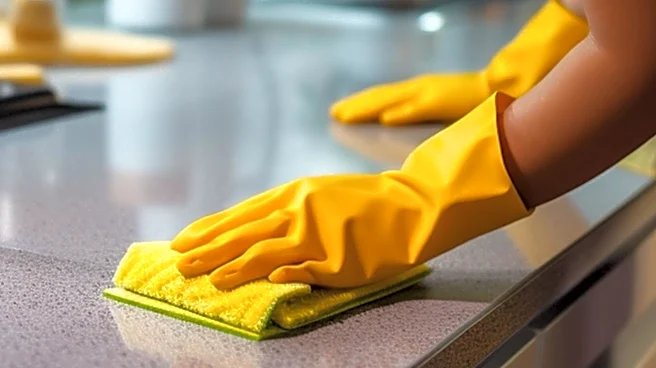
putting away food, and wiping counters—after dinner at friends' houses, often while the hosts are still socializing with other guests. Miss Manners clarified that such actions are not considered a 'nice gesture' but rather intrusive and potentially insulting. She explained that this behavior implies the host is neglecting necessary tasks and also detracts from the guest's primary duty of socializing. The proper etiquette, according to Miss Manners, is to offer help and then follow the host's directions, including desisting if the offer is declined, rather than independently managing the host's household.
Why It's Important?
This advice from Miss Manners highlights the subtle yet significant nuances of social etiquette, particularly in private settings like dinner parties. Understanding these unwritten rules is crucial for maintaining harmonious social relationships and avoiding unintentional offense. The issue underscores the importance of respecting boundaries and the host's autonomy in their own home. While the intention behind helping may be good, the execution can inadvertently convey a message of criticism or overstepping. For individuals navigating social interactions, this guidance serves as a reminder that hospitality involves a delicate balance of offering assistance and respecting the host's preferences, ensuring that guests contribute positively to the social atmosphere without disrupting the host's management of their home.
What's Next?
Individuals who have previously engaged in overzealous kitchen cleanup as guests may reconsider their approach, opting for more subtle offers of help or simply focusing on social engagement. Hosts might feel more empowered to gently guide guests who attempt to take over household tasks, reinforcing their preferences without causing awkwardness. The advice could lead to a broader re-evaluation of guest-host dynamics, encouraging clearer communication about expectations and roles during social gatherings. This guidance reinforces the idea that the primary role of a guest is to enjoy the company and contribute to the social fabric of the event, rather than assuming household responsibilities unless explicitly requested and directed by the host.
Beyond the Headlines
The discussion on guest etiquette, particularly regarding kitchen cleanup, touches upon deeper cultural understandings of hospitality, personal space, and social hierarchy within private homes. In some cultures, extensive help from guests might be seen as a sign of respect or closeness, while in others, it could be perceived as an intrusion. Miss Manners' advice reflects a particular cultural norm where the host maintains control over their domestic space, and guests are expected to respect that autonomy. This seemingly minor point of etiquette can reveal underlying assumptions about roles, responsibilities, and the unspoken rules that govern social interactions, highlighting how even well-intentioned actions can be misinterpreted if cultural or social norms are not aligned. It underscores the importance of social intelligence and sensitivity in navigating diverse social contexts.