


What's Happening?
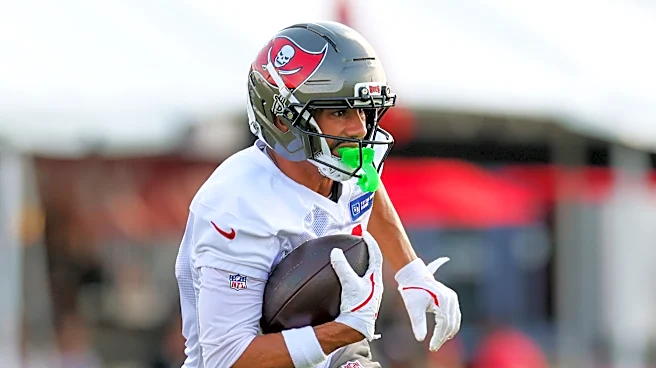
Conflicting assessments regarding rookie wide receiver Ted Hurst have emerged from the Tampa Bay Buccaneers coaching staff. Head coach Todd Bowles recently stated that Hurst needs to improve his grasp of the offense, route running, and hands to earn more
playing time, noting that Hurst played only one offensive snap in the game against the Chicago Bears. In contrast, offensive coordinator Zac Robinson offered a more positive evaluation of Hurst, praising the third-round draft pick for his performance as a rookie. Robinson highlighted Hurst's ability to play both X and Z receiver spots and back up Emeka Egbuka, commending his handling of these responsibilities. Robinson also discussed the ongoing learning curve for receivers in understanding the urgency and nuances required to succeed on game day, mentioning Tez Johnson's progress and Emeka Egbuka's need for continued growth.
Why It's Important?
The differing public statements from Head Coach Todd Bowles and Offensive Coordinator Zac Robinson regarding rookie receiver Ted Hurst are significant as they could indicate a lack of unified messaging or differing expectations within the Buccaneers' coaching staff. Such discrepancies can create confusion for players, potentially impacting their development and confidence. For Hurst, receiving mixed signals from his head coach and offensive coordinator could make it challenging to understand what specific improvements are prioritized. This situation also highlights the complexities of player evaluation and development in professional football, where coaches may have different perspectives on a player's readiness and potential. The performance of rookie players, especially those drafted in early rounds, is crucial for team building and future success, making consistent coaching feedback vital.
What's Next?
Ted Hurst's development and playing time will likely be closely monitored in the coming weeks. The Buccaneers' coaching staff will need to ensure a more cohesive approach to player evaluation and feedback to maximize Hurst's potential. The ongoing efforts by Zac Robinson to educate receivers on the urgency and strategic understanding required for game day will continue, with a focus on improving overall offensive execution. The team's performance in the passing game, which has been a point of concern, will depend on the collective improvement of its receivers and the clarity of coaching directives. How Hurst responds to these varied assessments and whether his playing time increases will be key indicators of his progress and the coaching staff's ability to align their development strategies.
Beyond the Headlines
The contrasting views on Ted Hurst could reflect broader philosophical differences within the Buccaneers' offensive coaching structure, particularly concerning player development and immediate readiness versus long-term potential. This dynamic can sometimes lead to internal friction or inefficiencies in player utilization. It also underscores the challenge of integrating rookie talent into a complex NFL offense, where the transition from college often requires significant adjustments in technique, mental processing, and understanding of professional schemes. The emphasis on 'urgency' and 'landmarks' by Robinson suggests a focus on fundamental execution and situational awareness, which are critical for offensive success. The situation with Hurst could serve as a case study for how NFL teams manage and communicate expectations for their young players amidst the pressures of professional competition.