






What's Happening?
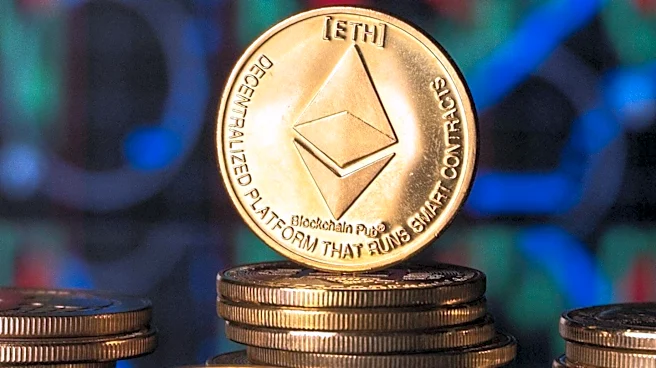
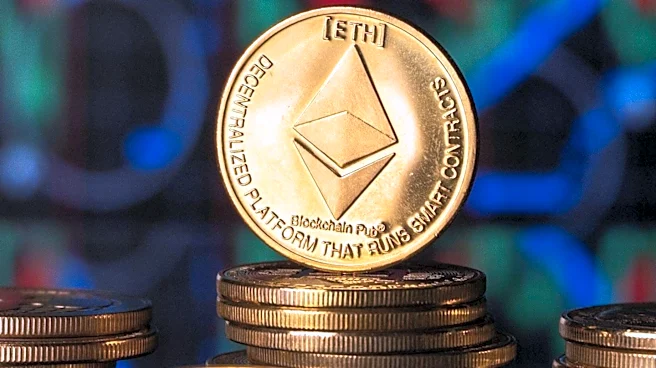
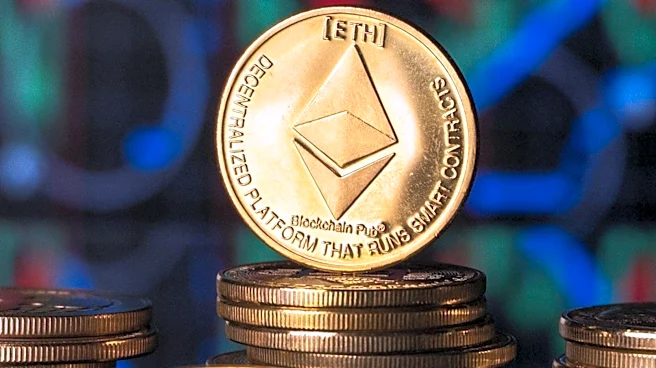
BitMine Immersion Technologies, formerly a Bitcoin mining company, has transitioned into the world's largest listed holder of Ethereum (ETH) under the chairmanship of Tom Lee, co-founder of Fundstrat Global Advisors. This strategic shift began on June
30, 2025, when BitMine announced a $250 million private placement, issuing over 55 million new shares at $4.50 each to investors including Founders Fund, Pantera, Galaxy Digital, and Kraken. The proceeds were primarily used to establish an Ethereum treasury. As of November 8, 2026, BitMine reported holding 6,070,092 ETH, representing 4.97 percent of all circulating ether. The company's strategy involves issuing new shares, using the capital to acquire more ETH, and staking a significant portion of its holdings through its MAVAN platform. While Bitcoin mining continues, it has become a secondary operation, with the company now focusing on institutional staking, Bitcoin mining, and strategic digital asset management.
Why It's Important?
This transformation is significant as it establishes BitMine as a major player in the Ethereum ecosystem, potentially influencing market dynamics and institutional interest in ETH. By becoming the largest listed ether holder, BitMine offers investors a leveraged proxy for ETH, allowing exposure to Ethereum's price movements through traditional stock markets. The company's strategy of continuously acquiring and staking ETH aims to generate ongoing revenue, which could justify a valuation above its net asset value. This approach mirrors Michael Saylor's strategy for Bitcoin treasury companies, but applied to Ethereum. The inclusion of BitMine in the Russell 1000 index further broadens its investor base, attracting index funds and other institutional investors. The success of BitMine's model could encourage other companies to adopt similar strategies, further integrating cryptocurrencies into traditional finance.
What's Next?
BitMine is nearing its stated goal of owning five percent of the entire ether supply, having reached 99 percent of this target. While this mark is not a hard limit, the company has already begun to slow its pace of ether purchases, redirecting more capital towards buying back its own shares when its market capitalization falls below its net asset value (mNAV below 1). This indicates a shift in strategy towards optimizing shareholder value through buybacks. Future actions will likely involve continued management of its Ethereum treasury, including staking operations through MAVAN to generate yield, and strategic share repurchases based on market conditions and its mNAV. The company's ability to maintain a valuation above its asset value will depend on investor confidence in its growth prospects and staking income.
Beyond the Headlines
The emergence of a single entity holding nearly five percent of all circulating ether raises questions about Ethereum's decentralization. While Tom Lee has suggested that even higher stakes would not endanger decentralization, some community members express skepticism regarding the influence large stakers could wield in network upgrades and governance decisions. Furthermore, BitMine has become a consistent buyer in the Ethereum market; any future decision to exit or sell a significant portion of its holdings could introduce substantial supply into the market, potentially impacting ETH prices. This development highlights the evolving landscape of cryptocurrency ownership, where institutional players are accumulating significant portions of digital assets, leading to discussions about market concentration and its implications for the broader crypto ecosystem.