



What's Happening?
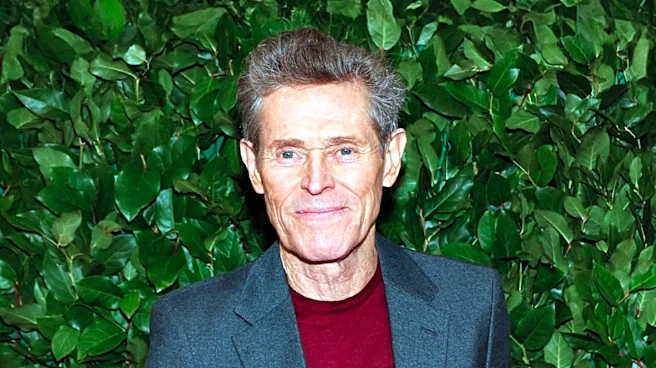
Willem Dafoe is starring in the film 'Late Fame,' an adaptation of an Austrian novella written by Arthur Schnitzler around 1910 and left unpublished for over a century until 2014. The story centers on Saxberger, a forgotten poet whose work is rediscovered
by a young admirer, Meyers (played by Obie Award winner Edmund Donovan). The script, adapted by Samy Burch, updates the narrative to modern-day New York City, where Saxberger works as a postal employee. Meyers introduces Saxberger to 'The Enthusiasm Society,' a collective whose hero worship challenges the poet. Dafoe, a four-time Oscar nominee, found personal resonance with the story's themes, particularly the nostalgia for the mid-1970s New York downtown scene and the experience of being asked about past eras. Magnolia Pictures is distributing the film in the U.S., with a commercial release scheduled for August, following its appearances on the awards circuit.
Why It's Important?
The release of 'Late Fame' with Willem Dafoe in a leading role highlights the enduring appeal of adapting classic literature for contemporary audiences, especially when it features acclaimed actors. Dafoe's involvement brings significant artistic credibility and commercial visibility to the project, potentially drawing a wider audience to a story that might otherwise remain niche. The film's exploration of themes such as artistic legacy, the seduction of admiration, and the passage of time offers a reflective commentary on the nature of fame and self-perception in the arts. For the U.S. film industry, this production demonstrates a continued interest in character-driven narratives and the potential for international literary works to find new life and relevance through American cinematic interpretation. The film's setting in New York City also grounds the universal themes in a recognizable cultural landscape, making it relatable to a domestic audience while maintaining its artistic depth.
What's Next?
Following its commercial release in August, 'Late Fame' is expected to continue its run on the awards circuit, potentially garnering further nominations and recognition, especially given Willem Dafoe's acclaimed performance. Dafoe himself has a busy schedule, with several other films slated for release in the coming months, including 'Tenzing,' 'Werwulf' (reuniting him with director Robert Eggers), 'Time Out' with Adam Sandler, and 'White Lies' directed by Oliver Stone. The success of 'Late Fame' could influence future adaptations of lesser-known literary works, encouraging studios to invest in projects that blend classic storytelling with contemporary settings and established talent. The film's reception will also be closely watched by critics and audiences interested in Dafoe's diverse acting choices and his continued collaboration with both established and emerging directors.
Beyond the Headlines
Beyond its immediate cinematic impact, 'Late Fame' delves into profound psychological and cultural implications. The narrative's core, a forgotten poet's re-emergence through the eyes of a young admirer, touches upon the cyclical nature of artistic appreciation and the human need for validation. Dafoe's personal connection to the character's experience of being asked about his 'early days' and the temptation to conform to others' expectations highlights the subtle pressures faced by public figures. This theme resonates deeply in an era dominated by social media and constant public scrutiny, where the line between authentic self and curated persona often blurs. The film implicitly questions the authenticity of hero worship and its potential to both inspire and corrupt an artist's integrity, offering a nuanced look at the dynamics between creator and audience. It also underscores the timeless struggle of artists to remain true to their vision amidst external influences and the passage of time.