




What's Happening?
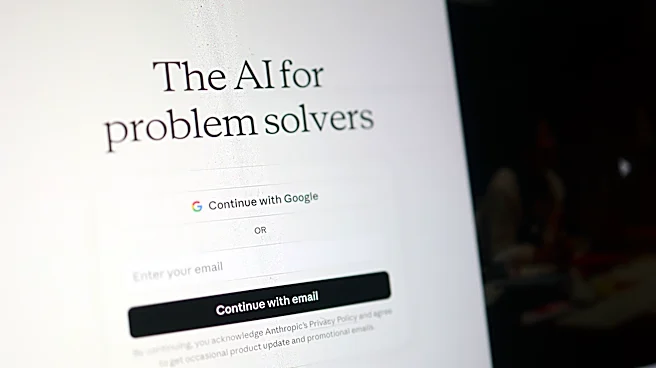
A broad coalition of scientists, legal scholars, and tech leaders has issued a statement, dubbed the 'MisAnthropic Statement,' challenging AI company Anthropic's claims of being a 'safe AI company' ahead of its initial public offering. The coalition,
which includes prominent figures such as Dan Hendrycks, Executive Director of the Center for AI Safety, and Max Tegmark, Professor of Physics at MIT, argues that Anthropic is engaging in a 'reckless attempt to amass power in the name of the greater good.' The statement asserts that Anthropic warns about the dangers of recursively self-improving AI but is actively working to build it first. Furthermore, the coalition claims that Anthropic has weakened its safety pledges and lobbied for self-serving regulations while using safety branding to attract investors, employees, and the public. This diverse group, comprising AI safety researchers, open-source advocates, AI ethicists, and accelerationists, is united in its rejection of Anthropic's public positioning as the industry's 'good guys.'
Why It's Important?
This challenge to Anthropic's safety branding is significant as it directly impacts public perception and investor confidence in the rapidly evolving AI industry. The coalition's accusations of weakened safety pledges and self-serving regulation could lead to increased scrutiny from policymakers and regulators regarding AI development practices. For investors, these claims introduce uncertainty about Anthropic's long-term ethical and operational stability, potentially affecting its IPO performance and valuation. The debate also highlights a growing schism within the AI community between those prioritizing rapid development and those advocating for stringent safety measures and ethical considerations. This public confrontation could set a precedent for how AI companies are held accountable for their stated commitments and influence future regulatory frameworks designed to govern advanced AI systems. The involvement of leading academics and industry figures lends considerable weight to the coalition's concerns, potentially shaping broader discussions about AI governance and corporate responsibility.
What's Next?
In the immediate future, Anthropic will likely face increased pressure to respond to the coalition's allegations, potentially impacting its IPO strategy and public relations efforts. The company may need to publicly address the claims regarding its safety pledges and lobbying activities to reassure investors and the public. Regulators and legislative bodies, already grappling with how to oversee AI, might take note of these concerns, potentially leading to calls for more robust oversight or investigations into AI safety claims. The coalition's statement could also galvanize other AI safety advocates and researchers, leading to further public discourse and potentially coordinated actions to push for greater transparency and accountability in the AI sector. The outcome of this challenge could influence how other AI companies approach their public messaging and safety commitments, especially as they seek investment or navigate regulatory landscapes.
Beyond the Headlines
The 'MisAnthropic Statement' delves into deeper ethical and philosophical questions surrounding the development of advanced AI. The coalition's core concern about Anthropic's pursuit of 'recursively self-improving AI' while simultaneously warning of its dangers highlights a fundamental tension in the AI industry: the race for technological advancement versus the imperative for responsible and safe development. This situation brings to the forefront the debate about who controls powerful AI technologies and whether companies can be trusted to self-regulate effectively. The coalition's diverse membership, including those with differing views on AI's future, underscores the broad concern about the potential for AI to concentrate power and escape human control. This event could mark a turning point in how the public and policymakers perceive AI companies, shifting from a focus on innovation to a more critical examination of their ethical frameworks, transparency, and genuine commitment to safety beyond marketing rhetoric. It also raises questions about the role of 'safety branding' in an industry where the long-term implications of its products are still largely unknown.