




What's Happening?
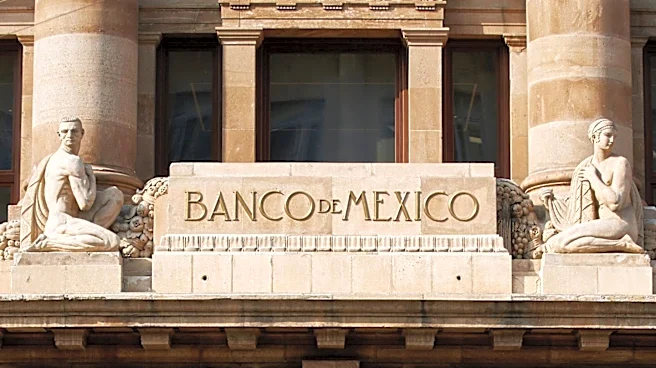
The Governing Board of the Bank of Mexico (BdeM) has decided by majority to reduce the target for the overnight interbank interest rate by a quarter of a percentage point, setting it at 6.25% effective November 6, 2026. This decision was made after the board
assessed that the disinflationary process is continuing and that there are no significant demand pressures within the economy. The vote was split, with Victoria Rodríguez Ceja, José Gabriel Cuadra García, and Omar Mejía Castelazo voting in favor of the cut, while Galia Borja Gómez and Jonathan Heath preferred to maintain the rate at 6.50%. The central bank characterized this adjustment as a one-time measure. Despite the rate cut, the BdeM noted that the economy continued to expand in the third quarter of 2026. Headline inflation saw a slight increase from 3.42% to 3.62% between mid-September and mid-October, primarily due to non-core inflation, while core inflation marginally decreased from 3.79% to 3.78% during the same period. The central bank has revised its headline inflation forecasts upward for the fourth quarter of 2026, projecting 3.7% for both headline and core inflation.
Why It's Important?
This interest rate cut by the Bank of Mexico signals the central bank's confidence in the ongoing disinflationary trend and the absence of excessive demand pressures, which could stimulate economic activity by making borrowing cheaper for businesses and consumers. For U.S. economic stakeholders, this move could have indirect implications. A more robust Mexican economy, spurred by lower interest rates, might lead to increased trade and investment opportunities for U.S. companies operating in or with Mexico. Conversely, a depreciating Mexican peso, as noted by the BdeM since its previous decision, could affect the competitiveness of U.S. exports to Mexico or alter the cost of Mexican imports for U.S. consumers. The BdeM also highlighted external factors, such as economic policy changes by the U.S. administration and geopolitical conflicts, as sources of uncertainty that could influence inflation in both directions. This interconnectedness means that U.S. businesses and investors with exposure to the Mexican market will need to monitor these developments closely, as changes in monetary policy and economic conditions in Mexico can impact cross-border financial flows and trade balances.
What's Next?
The Bank of Mexico intends to keep the interest rate at its new level for a prolonged period to support the convergence of inflation to its target and address external macroeconomic challenges. Future decisions will be based on observed and expected inflation behavior, as well as the pass-through of the exchange rate to consumer prices. The central bank's forecasts maintain the expectation that headline inflation will converge to its target in the fourth quarter of 2027, with projections of 3.4%, 3.3%, 3.2%, and 3.0% for the four quarters of 2027, consistent with previous estimates. However, these forecasts are subject to various risks. Upside risks for inflation include persistent core inflation, further depreciation of the peso, trade policy disruptions, inflationary impacts from geopolitical conflicts, climate effects, and cost pressures. Downside risks include lower-than-anticipated economic activity in Mexico and the United States, smaller pass-through of cost increases, and lower pressures from national currency appreciation. The BdeM estimates that the balance of risks remains skewed upwards, indicating continued vigilance will be necessary.
Beyond the Headlines
The Bank of Mexico's decision to cut interest rates, despite some upward revisions in short-term inflation forecasts, reflects a delicate balancing act between supporting economic growth and maintaining price stability. This move could signal a broader trend among central banks in emerging markets to ease monetary policy as disinflationary pressures take hold, potentially diverging from the more cautious stance of some advanced economies like the U.S. Federal Reserve, which recently kept its rates unchanged. The emphasis on external factors, particularly U.S. economic policy changes and geopolitical conflicts, underscores the increasing global interconnectedness and the challenges central banks face in managing domestic economies amidst international uncertainties. The potential for the Mexican peso to depreciate further could also have broader implications for regional economic stability and capital flows, as investors might seek higher yields elsewhere if the currency weakens significantly. This situation highlights the complex interplay between domestic monetary policy, global economic conditions, and geopolitical events, requiring continuous adaptation from policymakers.