



What's Happening?
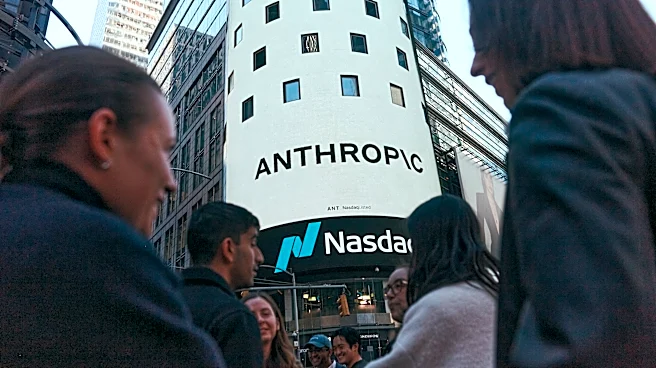
Anthropic, the AI company known for its Claude chatbot, successfully completed the largest Initial Public Offering (IPO) in history, raising $81.3 billion. The company priced its shares at $83, exceeding its initial expected range of $70 to $78, due to strong
demand. Anthropic sold approximately 980 million shares, surpassing the originally planned 825 million. This IPO valuation implies a market capitalization of roughly $1.5 trillion for the six-year-old company, exceeding SpaceX's previous record of $75 billion. Shares began trading on Nasdaq under the ticker ANT at $111.50, a 34% increase from the IPO price, briefly pushing the company's market capitalization to $2 trillion. However, the stock experienced a significant decline throughout its first day, closing around $94.67, approximately 14% above its offering price. This decline was unusually steep compared to other major U.S. IPOs since 2008. The broader market also saw a sell-off as Anthropic's stock began trading, with chip stocks like Nvidia and Broadcom erasing earlier gains. The pre-IPO perp market on Hyperliquid accurately predicted the deal pricing, trading above the initial range for weeks, indicating strong demand.
Why It's Important?
Anthropic's record IPO highlights the immense investor appetite for artificial intelligence companies, even amidst a period of significant market uncertainty and investor apprehension. The sheer scale of the capital raised demonstrates a strong belief in the future growth and transformative potential of AI technology. However, the stock's volatile first-day trading, with a substantial drop from its opening price, suggests underlying market caution and potential concerns about valuations in the AI sector. This event could influence future IPO strategies for other tech companies, particularly those in emerging high-growth sectors, by setting a precedent for both high demand and immediate post-listing price corrections. The broader market's reaction, including the sell-off in chip stocks, indicates that large-scale IPOs can have a ripple effect, potentially drawing liquidity from other risk assets and influencing overall market sentiment. The success of Hyperliquid's pre-IPO perp market also underscores the growing influence of decentralized finance platforms in providing alternative price discovery mechanisms for traditional financial events.
What's Next?
Listed ANT options are scheduled to begin trading on Monday, which will introduce new avenues for investors to speculate on or hedge against the stock's future performance. The performance of Anthropic's stock in the coming weeks will be closely watched as a bellwether for investor confidence in the AI sector and the broader tech market. Analysts will be scrutinizing the company's financial reports and strategic announcements to assess whether its valuation is sustainable. The significant capital raised will likely enable Anthropic to accelerate its research and development efforts, potentially leading to new advancements in AI technology and increased competition within the industry. The market will also observe whether the liquidity drain theorized to have been caused by the IPO will reverse, potentially providing some relief to other risk assets like Bitcoin. Future market sentiment will also be influenced by broader economic indicators and geopolitical developments, which currently contribute to investor unease.
Beyond the Headlines
The IPO of Anthropic, an AI company whose S-1 risk factors include 'the end of humanity,' occurs during a period of heightened societal anxiety, marked by recent cyber vulnerabilities, infrastructure outages, and a general sense of unease among investors. This juxtaposition highlights a complex societal relationship with rapidly advancing technology: immense investment in AI's potential coexists with deep-seated fears about its existential risks. The market's willingness to pour billions into a company that acknowledges such profound risks reflects a speculative environment where potential rewards often outweigh perceived dangers, or perhaps a belief that these risks can be managed. This event also underscores a broader cultural moment where discussions about AI's impact on society, from job displacement to ethical dilemmas, are becoming mainstream. The disconnect between the celebratory atmosphere of an IPO and the serious implications of the technology being funded points to a growing tension between technological progress and societal preparedness, raising questions about regulatory frameworks and the long-term implications of unchecked technological acceleration.