





What's Happening?
Bambu Lab has unveiled its third-generation 3D printer, the P3C, which aims to make advanced 'tool changer' technology accessible to a broader audience. Previously, this technology was exclusive to higher-end models like the $2,500 H3C. The new P3C is priced
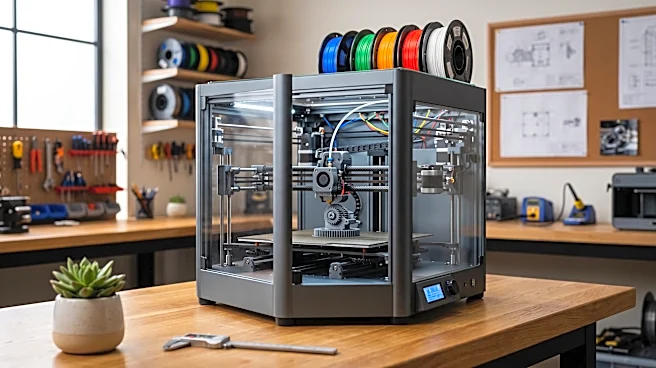
at $1,149, less than half the cost of its flagship counterpart. Key features include the Swaptek 7-tool changer, enabling material or color changes in just six seconds, which reduces waste and speeds up printing. The P3C also supports mixing different materials (e.g., rigid plastic and flexible rubber) and nozzle sizes (0.2mm to 0.8mm) mid-print. It comes with an integrated sealed AMS 3P filament management system, storing up to seven spools, and can connect to four external AMS units for up to 22 colors. Additionally, the P3C includes full-auto calibration and an AI monitoring system to detect issues like clogs, providing plain-language troubleshooting.
Why It's Important?
This release is significant for the U.S. 3D printing market, particularly for hobbyists, small studios, and educational institutions. By offering advanced multi-material and multi-color printing capabilities at a substantially lower price point, Bambu Lab is democratizing access to sophisticated 3D printing technology. This could spur innovation and creativity among a wider user base, leading to new applications and products. For small businesses, the P3C's efficiency and versatility could reduce prototyping costs and production times, making custom manufacturing more feasible. Educational institutions can now afford to equip their labs with more advanced tools, enhancing STEM education. The integrated AI monitoring and auto-calibration features also make 3D printing more approachable for newcomers, potentially expanding the overall market for 3D printers in the U.S. The ability to switch materials and nozzle sizes mid-print also opens up possibilities for more complex and functional designs.
What's Next?
The Bambu P3C 3D printer is available now worldwide, including in the U.S., for $1,149. The combo package includes the printer, AMS 3P, and five 0.4mm standard PrintTools, with two slots open for customization. While the P3C offers many advanced features, some compromises were made to achieve the lower price, such as a manual filament loading process for its five default nozzles, which is a step back from earlier motorized systems. Bambu Lab plans a software update to reduce manual loading time. The company aims to cater to a broader audience, including hobbyists and educational institutions. Future developments may focus on improving the manual loading experience or offering optional motorized AMS units at an additional cost. The market will observe how the P3C's balance of features and cost impacts its adoption compared to other 3D printers.
Beyond the Headlines
The P3C's introduction reflects a broader trend in technology: the continuous effort to make high-end capabilities more affordable and user-friendly. This democratization of advanced manufacturing tools could have long-term implications for local production and supply chains in the U.S. As more individuals and small entities gain access to sophisticated 3D printing, it could foster a new wave of entrepreneurship and localized manufacturing, potentially reducing reliance on overseas production for certain goods. The ethical implications of easier access to advanced manufacturing, such as the potential for printing restricted items, will also need to be considered. Furthermore, the integration of AI for monitoring and troubleshooting points towards a future where smart manufacturing processes become standard, making complex machinery more accessible and less intimidating for the average user.