


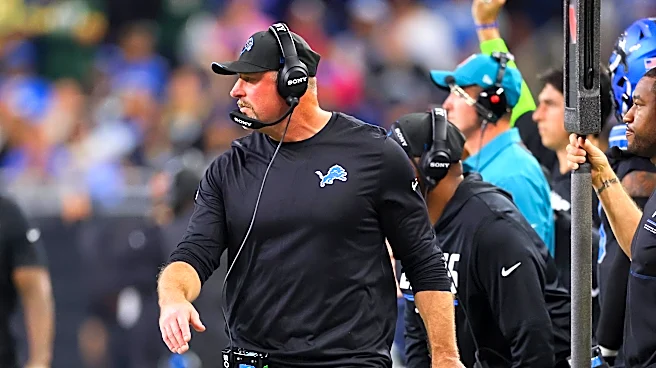

What's Happening?
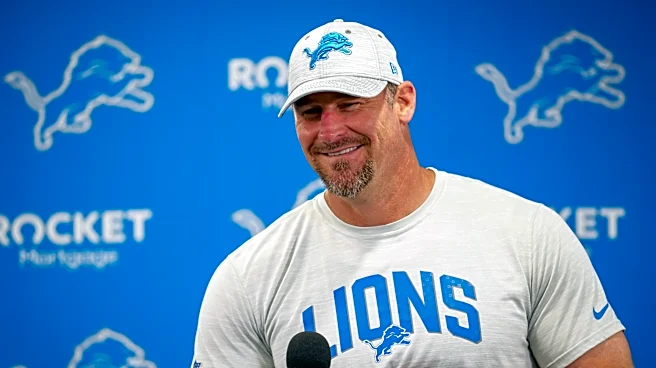
Detroit Lions coach Dan Campbell has stated that his aggressive approach to fourth-down decisions is rooted in his belief in his team's capabilities rather than statistical analysis. While analytics often suggest NFL teams should attempt fourth-down conversions
more frequently, Campbell emphasizes that each week presents unique circumstances, including opponent, roster, and weather conditions. He does not conduct extensive studies on success rates, instead relying on his intuition and confidence in his offense to gain a few yards when needed. Campbell's philosophy is influenced by his time playing for and coaching under Sean Payton, who similarly expressed strong confidence in his Saints' offense with players like Drew Brees and Alvin Kamara. This personal conviction guides his in-game choices, even when they might deviate from conventional coaching strategies.
Why It's Important?
Campbell's unconventional coaching style challenges traditional NFL decision-making, which often heavily relies on statistical probabilities and analytics. His emphasis on belief and situational awareness over pure data could influence other coaches to reconsider their own approaches, potentially leading to more dynamic and unpredictable game strategies across the league. For the Lions, this philosophy fosters a culture of aggression and confidence, which can be a significant psychological advantage for players. However, it also carries inherent risks, as failed fourth-down attempts can shift momentum and field position dramatically. This approach impacts not only game outcomes but also the broader discussion within professional football about the balance between human judgment and data-driven decisions, potentially shaping future coaching trends and player development strategies.
What's Next?
Campbell's continued adherence to his belief-driven fourth-down strategy will likely remain a focal point of discussion among NFL analysts and fans. As the season progresses, his success rate on these aggressive calls will be closely scrutinized, potentially validating or questioning his methodology. Other teams and coaches will observe the Lions' performance to see if this approach yields consistent positive results, which could lead to a broader adoption of similar strategies or a reinforcement of more conservative play-calling. The ongoing debate between analytics and coaching intuition will continue to evolve, with Campbell's decisions serving as a prominent case study in the league's strategic landscape.
Beyond the Headlines
The philosophical divide between data-driven decision-making and intuitive leadership extends beyond football, touching various fields from business to military strategy. Campbell's stance highlights the enduring value of human judgment, confidence, and team culture in high-stakes environments, even in an era dominated by advanced analytics. His approach suggests that while data provides valuable insights, it may not fully capture the intangible elements of team morale, player belief, and situational nuances that can influence outcomes. This raises deeper questions about the optimal blend of quantitative analysis and qualitative leadership, and how organizations can empower leaders to make bold decisions based on conviction, even when they defy conventional wisdom or statistical models.