
What's Happening?
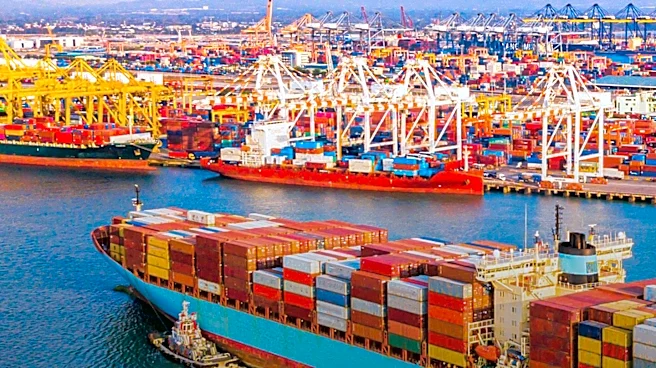
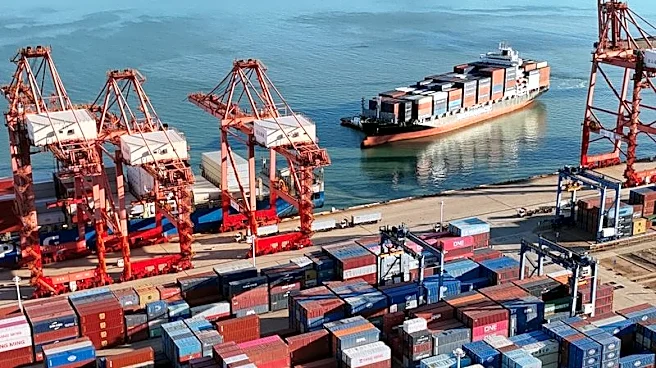
U.S. container imports achieved an all-time high in October, reaching 2,674,808 twenty-foot equivalent units (TEUs), according to a report from Descartes Systems Group. A significant portion of this increase
originated from China, with U.S. imports from China rising for the fourth consecutive month to 987,805 TEUs, marking the highest monthly volume since January 2025. To manage this surge, East and Gulf Coast ports gained market share over West Coast gateways. While port transit delays modestly increased for the third consecutive month in October, widespread port congestion has not yet materialized. Jackson Wood, VP, Product Management, Trade Regulations at Descartes, noted that this record volume demonstrates the resilience of U.S. maritime trade despite evolving trade policies and shipping conditions.
Why It's Important?
This record import volume is important as it indicates robust consumer demand and economic activity within the U.S., even amidst an uncertain global trade landscape. The significant increase in imports from China suggests a continued reliance on Chinese manufacturing for goods consumed in the U.S., despite ongoing trade tensions and efforts to diversify supply chains. The shift in port activity towards the East and Gulf Coasts highlights evolving logistics strategies and infrastructure capabilities, potentially driven by a desire to avoid West Coast congestion or optimize shipping routes. This trend has implications for port investments, inland transportation networks, and the overall efficiency of the U.S. supply chain, affecting businesses and consumers nationwide.
What's Next?
Importers are advised to continuously monitor tariff treatments, security risks on key shipping routes, and carrier routing decisions, as these factors can introduce uncertainty into cost and transit planning. The sustained high volume of imports, particularly from China, suggests that businesses are adapting to current trade policies and finding ways to maintain supply chains. Future developments will likely involve continued adjustments in shipping logistics and port operations to accommodate demand. The resilience of U.S. maritime imports in the face of a dynamic global trade environment indicates that businesses are prioritizing consistent supply, even if it means navigating complex trade regulations and potential cost fluctuations.
Beyond the Headlines
The record import volumes, particularly from China, underscore the deep interconnectedness of the global economy and the challenges of decoupling or significantly altering established trade relationships. Despite political rhetoric and tariff implementations, the economic realities of supply and demand continue to drive substantial trade flows. This situation also highlights the adaptability of global supply chains, which are constantly adjusting to geopolitical shifts, economic pressures, and logistical challenges. The ongoing need for importers to review tariff treatments and security risks points to a persistent state of flux in international trade, requiring businesses to maintain agile and informed strategies to ensure continuity and manage costs effectively.