


What's Happening?
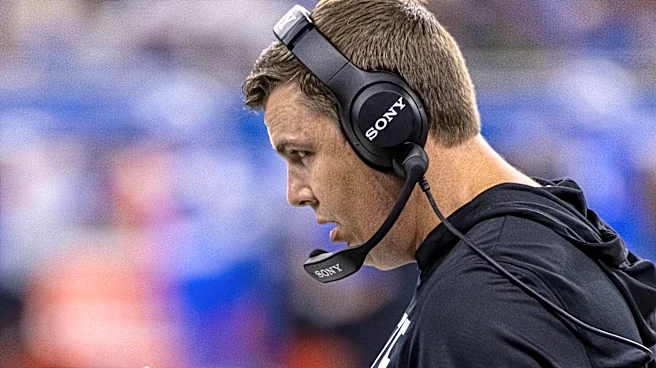
New Orleans Saints quarterback Tyler Shough has thrown for 1,721 yards, 13 touchdowns, and six interceptions in seven games this season, matching his interception total from his rookie year. The Saints are coming off a bye week, during which head coach
Kellen Moore fired run game coordinator T.J. Paganetti. This move comes as the Saints rank 28th in the NFL in rushing offense, averaging only 86.0 yards per game. In their last game, a 16-10 loss to the Pittsburgh Steelers in Paris, the team managed a mere 18 yards on 17 rushes. This significant struggle in the run game has placed considerable pressure on Shough and the passing offense. The Saints' offense has also been plagued by slow starts, being outscored 44-6 in the first quarter this season. Shough's individual performance has been notable despite these team-wide offensive challenges.
Why It's Important?
The Saints' anemic rushing attack significantly impacts Tyler Shough's performance and the overall offensive strategy. When a team cannot establish a run game, opposing defenses can focus more heavily on pass rush and coverage, making Shough's job considerably harder. The firing of the run game coordinator signals an acknowledgment of this critical weakness and an attempt to rectify it, which could, in turn, alleviate some pressure on Shough. However, the immediate impact of such a change remains to be seen. The team's slow starts are also a major concern, as falling behind early forces Shough into more high-pressure passing situations, increasing the risk of turnovers. For the Saints to improve their 2-5 record and contend, they need a more balanced and consistently performing offense, which hinges on both Shough's continued development and the effectiveness of the revamped run game strategy.
What's Next?
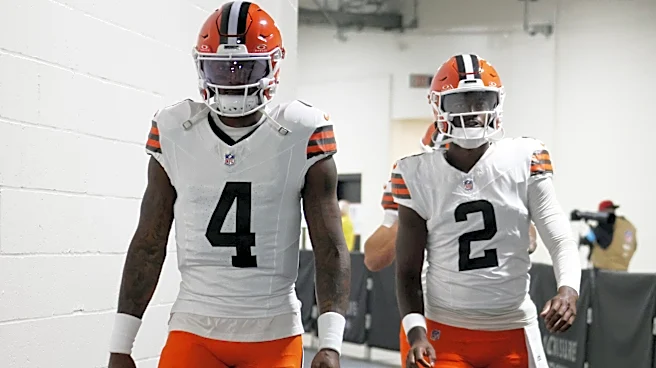
The Saints will face the Cleveland Browns in Week 9. This game will be a crucial test for Tyler Shough and the Saints' offense, particularly given the Browns' strong pass defense. The team's performance coming out of the bye week, especially after the coaching change, will be closely watched. Shough will need to demonstrate his ability to lead the offense more efficiently, particularly in the early stages of the game, to avoid falling into early deficits. The effectiveness of any adjustments made to the run game will also be a key factor in supporting Shough and creating a more balanced offensive attack. The outcome of this game and Shough's performance will likely influence further strategic decisions for the remainder of the season and potentially impact the team's long-term plans for the quarterback position.
Beyond the Headlines
The struggles of the Saints' run game and the subsequent coaching change highlight a common challenge in professional football: balancing offensive components to maximize quarterback performance. While Tyler Shough has shown individual talent, the systemic issues around him underscore how much a quarterback's success is intertwined with the overall team's functionality. The pressure on Shough is not just to perform individually but to elevate the entire offense despite its weaknesses. This situation can be a crucible for a young quarterback, either forging resilience and leadership or exposing limitations. The team's efforts to improve the run game are an implicit recognition that Shough cannot carry the entire offensive load alone. This dynamic illustrates the complex interplay between individual skill, team strategy, and coaching decisions in the high-stakes environment of the NFL.