




What's Happening?
Kodiak AI, a provider of Physical AI-powered autonomous vehicle technology, announced its third-quarter 2026 results, highlighting significant progress towards its year-end unsupervised autonomous long-haul launch. The company secured a binding agreement
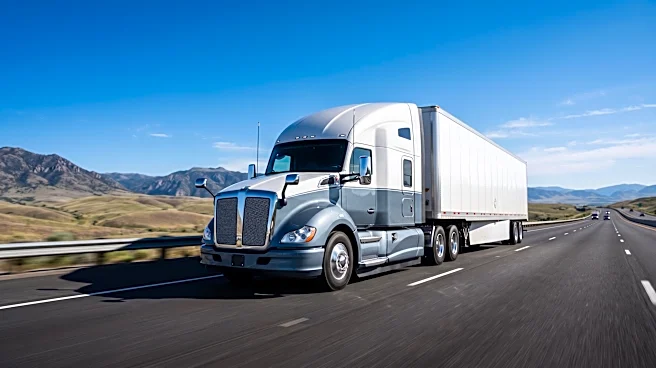
with DTL Transport to deploy the Kodiak Driver in 75 customer-owned and operated unsupervised autonomous trucks, marking a major commercial milestone. Kodiak AI's Autonomy Readiness Measure has reached 99%, nearing its target for unsupervised autonomous long-haul operations. The company also delivered the first Kodiak-powered Western Star 49X trucks to Atlas Energy Solutions, bringing Atlas's fleet of customer-owned autonomous trucks to 37. Additionally, International LT was selected as Kodiak's third OEM platform, with unsupervised autonomous deployments targeted for the second half of 2027. IKEA Supply was named as Kodiak's first long-haul launch partner for unsupervised autonomous operations, with plans to begin regular commercial freight service along the Dallas-to-Houston corridor. Kodiak AI reported a 286% year-over-year revenue growth, driven by expanding Driver-as-a-Service operations and a one-time Defense contribution.
Why It's Important?
Kodiak AI's advancements in autonomous trucking technology hold significant implications for the U.S. logistics and transportation sectors. The agreement with DTL Transport and the partnership with IKEA Supply signal a growing adoption of unsupervised autonomous trucks for commercial freight, which could revolutionize supply chain efficiency, reduce operational costs, and address driver shortages. The expansion to a third OEM platform (International LT) demonstrates the versatility and scalability of Kodiak's technology, potentially accelerating its integration across various trucking fleets. The targeted launch of unsupervised autonomous long-haul operations on U.S. highways could set new industry standards for safety and reliability, impacting regulatory frameworks and insurance models. Furthermore, the substantial revenue growth indicates a strong market demand for autonomous solutions, positioning Kodiak AI as a key player in the future of freight transportation and potentially influencing investment trends in the autonomous vehicle industry.
What's Next?
Kodiak AI is on track for its targeted year-end unsupervised autonomous long-haul launch, with its Autonomy Readiness Measure at 99%. The company plans to begin regular unsupervised autonomous freight service along the Dallas-to-Houston corridor with IKEA Supply. Engineering integration for the International LT platform is underway, with deployments expected in the second half of 2027. Kodiak AI will continue to focus on growing recurring revenue, reducing the cost of the Kodiak Driver, and improving operating leverage as deployments scale. The company is also scheduled to present at several investor conferences in November and December 2026, which may provide further insights into its commercial strategy and financial outlook. The successful deployment and scaling of these autonomous operations will be crucial for demonstrating the long-term viability and economic benefits of unsupervised autonomous trucking in the U.S.
Beyond the Headlines
The rise of unsupervised autonomous trucking, as spearheaded by companies like Kodiak AI, presents profound societal and economic shifts beyond mere logistical improvements. The widespread adoption of this technology could lead to a re-evaluation of labor markets, particularly for truck drivers, necessitating new training programs and job opportunities in areas like remote monitoring and maintenance of autonomous fleets. Ethical considerations surrounding autonomous decision-making in complex road scenarios will also become more prominent, potentially leading to new legal precedents and public policy debates. The ability to operate trucks without human intervention could also enhance national security by enabling more resilient supply chains and potentially supporting defense applications, as indicated by Kodiak's work with the U.S. Marine Corps. This technological leap could fundamentally alter the landscape of American commerce, influencing urban planning, infrastructure development, and the overall competitiveness of U.S. industries on a global scale.