







What's Happening?
Ricoh Company, Ltd. and ETRIA CO., LTD. have jointly announced 'Circular New,' a new manufacturing concept designed to transform products already in use into assets for future production. This initiative aims to integrate resource circulation into new product value
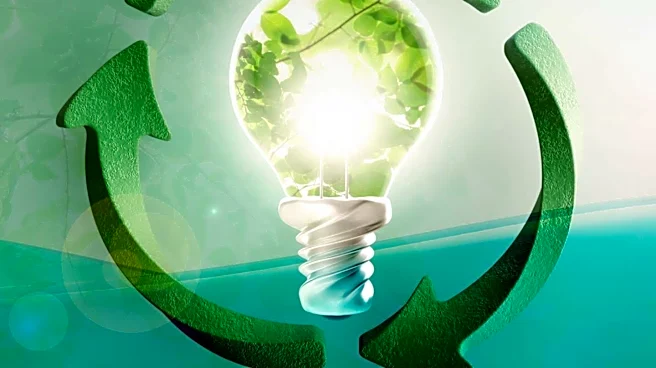
and manufacturing competitiveness. The first application of this concept will be introduced to Ricoh's A3 black and white multifunction printers (MFPs), with localized production and launch planned for Japan and Europe in the first half of 2027. The 'Circular New' model seeks to reduce the proportion of newly sourced materials used from approximately 76% to as low as 21%. This is expected to result in a product carbon footprint reduction of up to 25%. The concept involves a continuous loop of product planning, design, manufacturing, use, collection, and reuse, utilizing existing market products as assets for new product creation. Localized circular production will be established in Japan and France to create regional loops for resource and component reuse, enhancing supply chain resilience and manufacturing competitiveness.
Why It's Important?
The 'Circular New' concept is significant as it directly addresses the growing global demand for sustainable manufacturing practices and resource efficiency. By drastically reducing the reliance on newly sourced materials and shortening transportation distances through localized production, Ricoh and ETRIA are setting a precedent for how companies can mitigate environmental impact while maintaining product quality and functionality. This approach strengthens supply chain resilience, making it less vulnerable to geopolitical risks, logistics disruptions, and resource price volatility. For consumers, it means receiving the latest-generation models with consistent quality, functionality, and warranty, regardless of the production method. This initiative also aligns with Ricoh's Mid-Term Management Strategy '26, which targets a 30% engine market share for ETRIA by fiscal 2030, demonstrating how environmental, social, and governance (ESG) goals can be integrated with business growth to create competitive advantages.
What's Next?
Following the announcement, Ricoh and ETRIA plan to launch localized production of A3 black and white MFPs under the 'Circular New' concept in Japan and Europe during the first half of 2027. This initial rollout will serve as a practical demonstration of the concept's effectiveness in reducing material consumption and carbon footprint. The companies aim to expand this circularity by establishing regional loops for resource and component reuse, moving beyond the initial application to other product lines. Ricoh's executive corporate officer and CEO of ETRIA, Katsunori Nakata, stated the goal of reducing newly sourced material use to 60% by 2030 and 12% by 2050, indicating a long-term commitment to evolving circularity. The success of this localized production model will likely influence future manufacturing strategies within Ricoh and potentially inspire other industries to adopt similar resource circulation approaches.
Beyond the Headlines
The 'Circular New' concept represents a fundamental shift from a linear 'take-make-dispose' economy to a circular one, where products are designed for longevity, reuse, and regeneration. This initiative highlights the ethical imperative for corporations to minimize their environmental footprint and contribute to a more sustainable future. By integrating digital insights into product and component conditions with advanced sorting and quality assurance technologies, Ricoh and ETRIA are pushing the boundaries of what's possible in resource recovery. This approach not only reduces waste and carbon emissions but also fosters innovation in design and manufacturing processes. The emphasis on localized production could also lead to economic benefits for regional communities by creating new jobs and strengthening local supply chains, thereby contributing to broader societal well-being beyond environmental gains.