





What's Happening?
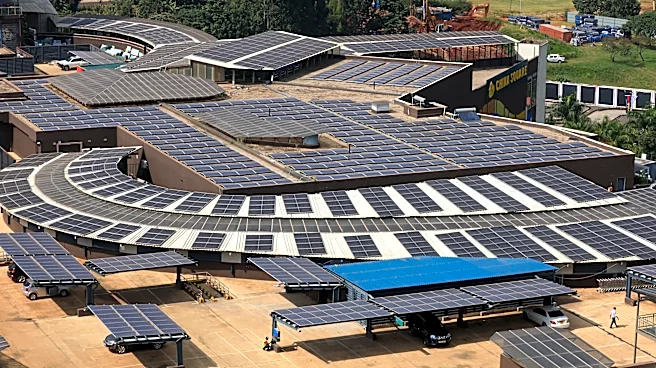
India is positioning itself as a significant player in the global solar manufacturing industry, aiming to diversify the supply chain currently dominated by China. With over 80% of the world's solar modules and 95% of solar wafers produced in China, India is leveraging
its rapidly growing renewable energy market and supportive industrial policies to expand its domestic manufacturing capacity. The country has seen a substantial increase in its module manufacturing capacity, now exceeding 200 GW annually, and is working to reduce its dependence on imported polysilicon and wafers. This strategic shift is driven by the need for supply chain resilience, highlighted by recent geopolitical tensions and the COVID-19 pandemic.
Why It's Important?
The diversification of the solar manufacturing supply chain is crucial for energy security and economic stability. By reducing reliance on Chinese imports, India can mitigate risks associated with trade disruptions and pricing volatility. This move also aligns with global efforts to decentralize manufacturing hubs, enhancing economic resilience. For the U.S. and other countries, India's emergence as a solar manufacturing hub offers an alternative source for solar components, potentially reducing costs and increasing supply chain reliability. This development could also foster international collaborations, further integrating India into the global clean energy market.
What's Next?
India's focus will likely shift towards expanding its upstream manufacturing capabilities, particularly in polysilicon and wafer production. The government is expected to continue supporting this growth through policies like the Production Linked Incentive Scheme and strategic partnerships with countries like the U.S., Europe, and Japan. As India strengthens its position, it may attract more foreign investment and technology transfers, further boosting its manufacturing capabilities. The global solar industry will be watching closely to see how India navigates these challenges and opportunities, potentially reshaping the global solar supply chain landscape.