




What's Happening?
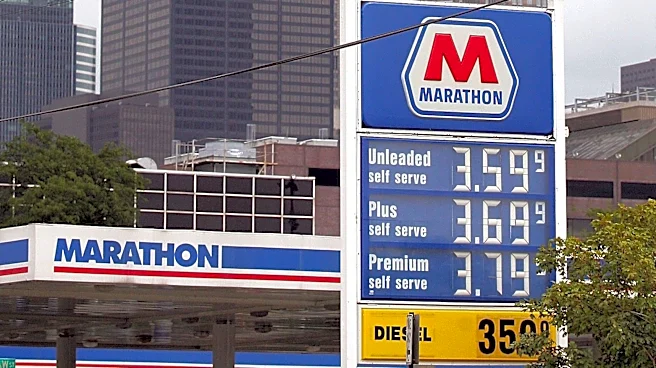
Marathon Petroleum Corporation is reportedly close to finalizing a deal to sell several of its refineries to CVR Energy for approximately $4 billion. This development comes as the refining sector experiences a significant boom, with refining margins reaching
all-time highs. The Wall Street Journal, citing unnamed sources, indicates that an announcement could be made soon. The current market conditions, influenced by global events such as conflicts in the Persian Gulf and Russia-Ukraine, have severely impacted global fuel supply, leading to increased demand and profitability for refiners outside these conflict zones. U.S. Gulf Coast operators, for instance, saw refining margins peak at $72 per barrel in September, a substantial increase from previous levels. CVR Energy, which is 71% owned by Carl Icahn, is the seventh-largest publicly traded refiner in the U.S., despite being significantly smaller than Marathon Petroleum.
Why It's Important?
This potential $4 billion refinery sale highlights the strategic shifts occurring within the U.S. energy sector, driven by unprecedented refining profitability. For Marathon Petroleum, divesting these assets could streamline its operations or provide capital for other investments, potentially focusing on its core strengths or other growth areas. For CVR Energy, acquiring these refineries would significantly expand its refining capacity and market share, positioning it to capitalize further on the current high-margin environment. The broader U.S. economy benefits from increased domestic refining capacity, which helps stabilize fuel prices and reduce reliance on imported refined products. However, the sustainability of these high margins is a key concern, as they are largely a result of geopolitical instability and supply disruptions. The deal also underscores a trend where other major players like Valero, Exxon, and Chevron are investing in or restarting refinery operations to meet demand, indicating a renewed focus on domestic refining capabilities.
What's Next?
The anticipated announcement of the deal between Marathon Petroleum and CVR Energy will likely provide more details on the specific refineries involved and the financial terms. Following the acquisition, CVR Energy will face the challenge of integrating these new assets into its existing operations and optimizing their performance to maintain profitability in a volatile market. The refining sector will continue to be influenced by global geopolitical developments and crude oil supply dynamics. Any resolution or escalation of conflicts could impact crude flows and product demand, thereby affecting refining margins. Additionally, policy decisions regarding fuel exports and regulations, such as the Jones Act, will remain critical factors influencing the business environment for U.S. refiners. Investors will closely monitor how these companies manage their expanded capacities and adapt to evolving market conditions.
Beyond the Headlines
The surge in refining margins and the subsequent acquisition activity reveal a deeper vulnerability in the global energy infrastructure: a shortage of refining capacity. Over the past two decades, many refineries, particularly in Europe, were closed or converted to biofuel plants as part of a broader shift towards alternative energy sources. The current geopolitical landscape has exposed the consequences of this trend, demonstrating that the world lacks sufficient capacity to meet fuel demand during periods of disruption. This situation raises questions about energy security and the balance between transitioning to renewable energy and maintaining a robust conventional energy infrastructure. The U.S. is now seeing a reversal of this trend, with companies investing in refining to secure domestic fuel supplies. This could lead to a re-evaluation of long-term energy policies, potentially emphasizing the strategic importance of domestic refining capabilities for national security and economic stability, even as the push for decarbonization continues.