






What's Happening?
The global all-terrain robot market is experiencing significant growth, with a projected increase from USD 1.65 billion in 2024 to USD 3.95 billion by 2030, at a compound annual growth rate (CAGR) of 14.2%. This expansion is driven by demand in defense
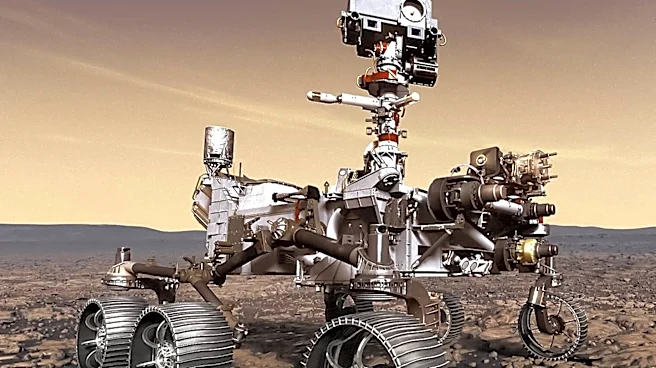
operations, industrial asset inspections, nuclear decommissioning, and hazardous-site monitoring, where worker safety, inspection efficiency, and reduced operating costs are priorities. Industrial deployments are showing market adoption, with over 200 ANYmal robots in use worldwide by March 2026 and over 50 industrial customers conducting more than 120,000 robotic inspections monthly by October 2026. Latin America, including Chile and Peru, presents niche opportunities in mining, while the Middle East & Africa region shows potential in oilfield automation and border security. Modern all-terrain robots are equipped with multi-modal sensor arrays for 3D environment modeling, crucial for applications like mine rescue and underground pipeline inspection.
Why It's Important?
The increasing adoption of all-terrain robots has significant implications for U.S. industries, particularly in sectors involving hazardous environments such as mining, oil & gas, and defense. These robots enhance worker safety by performing tasks in dangerous or inaccessible areas, reducing human exposure to risks. Their ability to conduct autonomous inspections and monitoring improves operational efficiency and can lead to substantial cost savings by minimizing downtime and optimizing maintenance schedules. For the U.S. economy, this growth signifies a burgeoning market for robotics manufacturers and technology developers, fostering innovation and job creation in advanced manufacturing and AI. Companies that invest in these technologies stand to gain a competitive edge through improved safety records, operational effectiveness, and potentially lower insurance costs. The development of advanced sensor fusion and AI-driven autonomy in these robots also pushes the boundaries of technological capabilities, benefiting various applications beyond their primary use.
What's Next?
The all-terrain robot market is expected to continue its rapid evolution, driven by advancements in AI-driven autonomy, advanced mobility systems, multi-modal perception, and collaborative robotics. The integration of AI and edge-based decision systems will enable robots to navigate independently and adapt to changing environments in real-time. Innovation in legged robotics, mimicking animal locomotion, will allow robots to traverse complex terrains like stairs and rubble, expanding their utility in disaster relief and military reconnaissance. The development of modular robot bases, capable of supporting interchangeable payloads, will attract customers from diverse sectors like oil & gas and environmental science. Continued funding from defense agencies and research institutions, along with strategic partnerships between startups and established firms, will accelerate the development and deployment of these advanced robotic systems. Regulatory frameworks will also need to evolve to address operational safety and liability concerns for autonomous systems.
Beyond the Headlines
Beyond the immediate economic and safety benefits, the widespread adoption of all-terrain robots raises deeper implications concerning the future of labor and ethical considerations in autonomous systems. As robots take over more hazardous and routine tasks, there will be a shift in workforce demands, requiring new skills in robot operation, maintenance, and programming. This could lead to job displacement in some areas but create new opportunities in others. Ethically, the increasing autonomy of these robots, particularly in defense applications, necessitates careful consideration of decision-making processes and accountability. The ability of robots to recognize environmental patterns and make independent navigation choices in critical situations, such as mine rescue, highlights the need for robust ethical guidelines and regulatory oversight to ensure their responsible deployment and prevent unintended consequences. The long-term societal impact will depend on how these technological advancements are integrated with human values and regulatory frameworks.