






What's Happening?
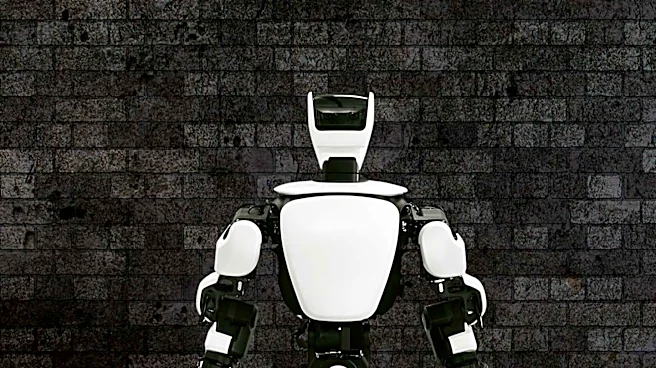
Walden Robotics cofounder and CEO Russ Tedrake discussed the evolving landscape of humanoid robot design, emphasizing a 'practical humanoid' approach that incorporates wheels for industrial applications. During an interview at the Physical AI conference,
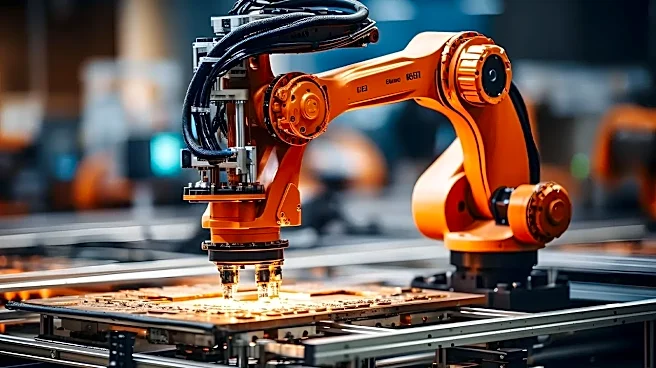
Minds in Motion, Tedrake highlighted the debate between fully humanoid, walking robots and more equipment-style robots, often on wheels. While acknowledging the benefits of human-like form factors for intuitive interaction and teleoperation, Tedrake noted that Walden Robotics' current robots, despite his background in legged robotics, utilize wheels for efficiency in factory settings. This design choice is driven by the immediate market need for robots that can perform tasks in manufacturing, aerospace, semiconductor, and biotech industries, where reliability and mobility are paramount.
Why It's Important?
This discussion from Walden Robotics underscores a pragmatic shift in humanoid robot development, prioritizing functionality and immediate industrial applicability over purely human-like locomotion. The integration of wheels into humanoid designs addresses practical challenges in environments like factories, where smooth, predictable movement is often more critical than bipedal walking. This approach can accelerate the adoption of robots in manufacturing sectors facing labor shortages and demanding repetitive tasks. By focusing on 'practical humanoids,' companies can deliver solutions that are more robust, energy-efficient, and cost-effective for current industrial needs, thereby driving economic growth and improving productivity in key U.S. industries. It also highlights the ongoing evolution of AI models, such as Large Behavior Models (LBMs), which are crucial for programming these advanced robots.
What's Next?
The trend towards 'practical humanoid' designs with wheels suggests that future industrial robots will likely blend human-like manipulation capabilities with efficient wheeled mobility. This could lead to more versatile robots capable of navigating complex factory floors while performing intricate tasks. Further development will likely focus on refining the balance between human-like features (like arms and hands) and practical mobility solutions. As AI and machine learning continue to advance, these robots will become more adept at understanding and interacting with their environments, potentially leading to wider deployment across various manufacturing and logistics sectors. The ongoing research into models like LBMs, Vision Language Action (VLA) models, and World Action Models (WAM) will be critical in enabling robots to learn and adapt more effectively.
Beyond the Headlines
The debate between fully bipedal and wheeled humanoid robots touches upon deeper philosophical and ethical considerations regarding the future of human-robot interaction. While fully humanoid robots might foster greater comfort and understanding in human co-workers due to familiar movements, the 'practical humanoid' approach prioritizes efficiency and utility. This pragmatic design choice reflects a broader industrial strategy to deploy robots where they can provide the most immediate value, often in tasks that are physically demanding or undesirable for humans. Ethically, this focus on practical application can lead to significant improvements in worker safety and productivity. However, it also raises questions about the long-term impact on human employment and the need for a societal framework that supports workforce transition as automation advances. The discussion also highlights the significant computational resources required for training these advanced robotic systems, pointing to the environmental footprint of AI development.