









What's Happening?
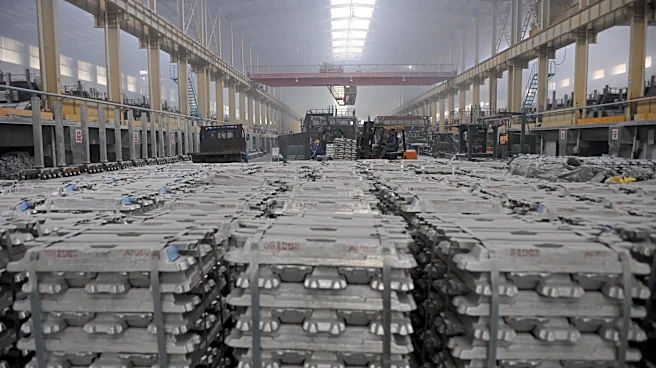
The U.S. defense industry is currently grappling with the challenge of increasing production throughput to meet growing demands for critical defense systems. According to a report by Deloitte, the focus is shifting from merely securing contracts through innovation
to ensuring the ability to deliver products at scale and with quality. The three largest U.S. defense contractors have a combined backlog of $557 billion, indicating a significant demand for increased production capacity. This backlog is equivalent to 2.7 times their annual sales for 2025, suggesting a 30-month order coverage horizon at current revenue rates. The industry is under pressure to expand production of systems such as air and missile defense interceptors and long-range precision munitions. The report emphasizes the need for defense companies to improve industrialization across operations, supply chains, and emerging industry ecosystems to address these challenges.
Why It's Important?
The ability to increase production throughput is crucial for maintaining U.S. defense readiness and meeting operational demands. As geopolitical tensions rise, the need for a robust defense supply chain becomes more critical. The current backlog and production constraints could impact the U.S. military's ability to replenish stockpiles and sustain operations. This situation highlights the importance of industrialization in defense manufacturing, which involves translating proven designs into repeatable production and sustaining output under demand shocks. Addressing these challenges is vital for ensuring that the U.S. defense industry can meet both current and future needs, thereby maintaining national security and strategic advantage.
What's Next?
To overcome production constraints, defense companies may need to adopt new strategies such as automating manufacturing processes and expanding partnerships. This could involve investing in robotics, digital manufacturing tools, and advanced inspection technologies to increase yield and quality without additional labor. Additionally, distributed manufacturing, which involves shifting production across a network of sites and partners, may be necessary to meet rising demand. Companies might also consider strategic acquisitions to address limited production capacity and sustainment challenges. These steps are essential for narrowing the gap between consumption and replenishment, ensuring that the U.S. defense industry can meet its strategic objectives.
Beyond the Headlines
The push for increased production throughput in the defense industry also raises ethical and compliance considerations. Federal rules enforcing strict cybersecurity standards throughout the defense supply chain can introduce onboarding friction, particularly for smaller suppliers. This could limit the pool of eligible vendors and shift risks to prime contractors. Moreover, the need for rapid qualification of suppliers and processes highlights the importance of compliance as a throughput constraint. Addressing these issues requires a collaborative approach, where primes work with suppliers to scale through joint readiness or qualification efforts. This ecosystem approach to industrialization is crucial for overcoming production bottlenecks and ensuring a resilient defense supply chain.