






What's Happening?
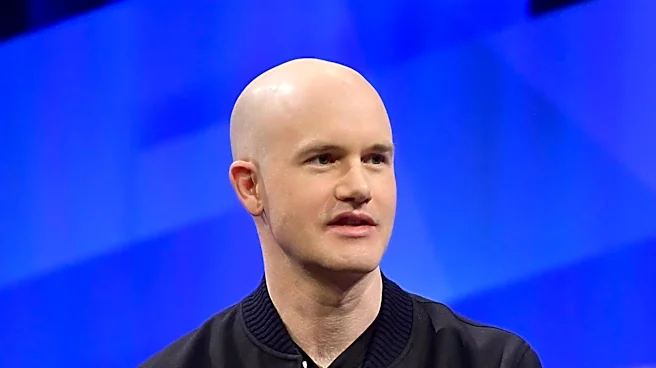
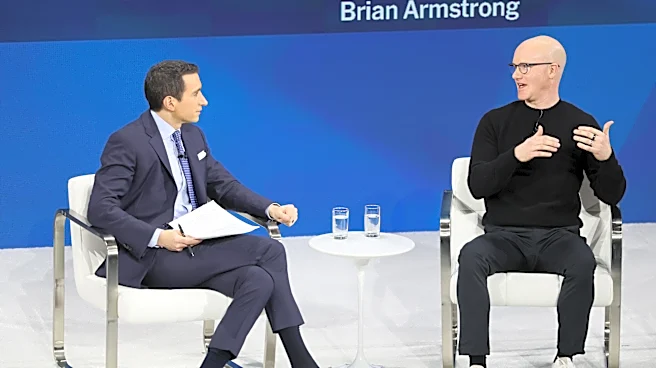
Brian Armstrong, CEO of Coinbase, has implemented a management structure for artificial intelligence agents within the company. He oversees seven or eight lead AI agents, each focused on specific areas, with a single chief-of-staff agent providing overall
supervision. These lead agents are capable of spinning up their own sub-agents to handle various subtasks. Armstrong assesses the output of these AI agents as comparable to that of mid-career engineers, specifically rating them at an 'L5, L6' employee level within a typical tech company grading system. He noted that while AI agents can work continuously and replicate themselves, they sometimes lack the broader perspective of human employees. Coinbase has shifted from simply prompting AI models to delegating areas of responsibility and goals to these agents, which then propose decisions for human approval, such as analyzing onboarding data and identifying opportunities.
Why It's Important?
This development highlights a significant shift in how companies, particularly in the technology and finance sectors, are integrating advanced AI into their operational structures. Armstrong's approach suggests a future where AI agents are not just tools but integral parts of an organizational chart, capable of performing complex tasks and making data-driven proposals. The ability of these agents to operate at the level of mid-career engineers could lead to substantial increases in efficiency and productivity, potentially redefining workforce composition and management strategies. For the U.S. business landscape, this could mean a competitive advantage for companies that effectively deploy similar AI frameworks, while also raising questions about the future roles of human employees and the skills required in an increasingly AI-driven economy. The emphasis on stablecoins as the payment rail for an 'agentic economy' also signals a potential future where cryptocurrency plays a central role in automated financial transactions.
What's Next?
Armstrong anticipates a future where AI agents will handle a vast majority of global financial transactions, potentially up to 99.999% within a decade, with stablecoins serving as the primary payment rail. While he did not predict a reduction in Coinbase's human workforce, currently around 4,000 people, he suggested that human employees would be empowered to achieve significantly more with AI assistance. The company is also building a 'brain' for every employee, team, and GitHub repository, which ingests internal data like meeting transcripts and code reviews to provide AI agents with company-specific context. This ongoing integration suggests a continuous evolution of human-AI collaboration, where human roles increasingly involve aligning and overseeing AI rather than performing repetitive tasks. Future developments will likely focus on refining these AI agent capabilities and expanding their areas of responsibility within the company.
Beyond the Headlines
The integration of AI agents into a hierarchical management structure, as described by Armstrong, raises profound questions about the nature of work, corporate organization, and ethical considerations in decision-making. While AI agents are presented as highly efficient 'employees,' the comparison to human roles, even with caveats, blurs the lines between artificial and human intelligence in the workplace. The concept of an 'agentic economy' where AI agents transact with each other using stablecoins could lead to unprecedented levels of automation in finance, potentially impacting traditional banking systems and regulatory frameworks. Furthermore, the idea of a 'brain' for every employee and team, distilling lessons overnight, points to a future where institutional knowledge is continuously processed and leveraged by AI, potentially accelerating innovation but also raising concerns about data privacy, algorithmic bias, and the ultimate accountability for AI-driven decisions. The long-term societal implications of such widespread AI autonomy in business operations warrant careful consideration.