




What's Happening?
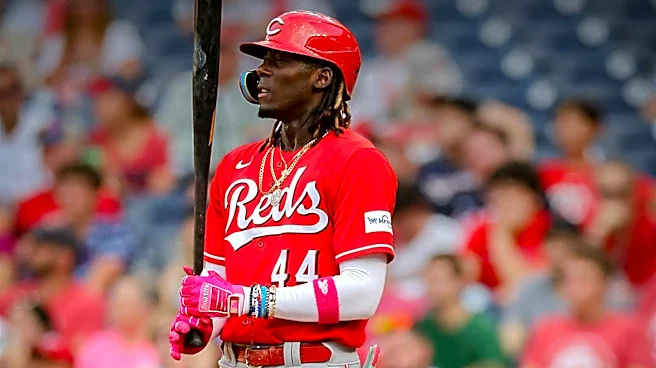
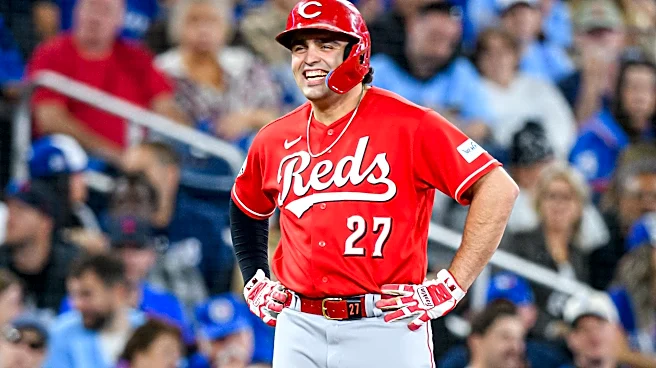
A recent trade proposal by Bleacher Report's Zachary D. Rymer suggests a significant offseason move in Major League Baseball, involving Cincinnati Reds shortstop Elly De La Cruz. The proposal outlines De La Cruz being traded to the Tampa Bay Rays in exchange
for three prospects: shortstop Grady Emerson (MLB No. 12 prospect), catcher Caden Bodine (MLB No. 41 prospect), and right-handed pitcher Brody Hopkins. De La Cruz, 24, is coming off a strong season where he slashed .283/.365/.515 with 30 home runs, 79 RBIs, and 30 stolen bases, achieving an .880 OPS and 5.6 WAR. He remains under team control through the 2029 season. The Reds would receive a package of young talent, including Emerson, an 18-year-old selected second overall in the 2026 MLB Draft, and Bodine, a 22-year-old catcher who had an impressive 2026 minor league season. Hopkins, a 24-year-old pitcher, spent most of 2026 with Triple-A Durham and made six appearances with the Rays.
Why It's Important?
This trade proposal highlights a potential shift in strategy for both the Cincinnati Reds and the Tampa Bay Rays, reflecting different organizational philosophies. For the Reds, trading a star player like De La Cruz, who is under team control for several more years, would signify a commitment to rebuilding through prospects. Such a move would be a high-risk, high-reward scenario, as the development of prospects is inherently uncertain. The Rays, known for developing young talent and trading established players, would be deviating from their typical approach by acquiring a player like De La Cruz for multiple premium prospects. This indicates a potential willingness to invest heavily in a proven, high-impact player to bolster their lineup. The success or failure of such a trade could significantly impact the competitive landscape of MLB, influencing how other teams approach player development, trades, and long-term contracts. It also underscores the value placed on top-tier prospects in the current baseball market.
What's Next?
While this is currently a trade proposal and there's no indication of active discussions between the Reds and Rays, the concept raises questions about the Reds' offseason strategy. The Reds would likely require an 'absolute haul' of prospects, potentially more than what Rymer proposed, to consider moving a player of De La Cruz's caliber with three years of team control remaining. Given his agent, Scott Boras, a long-term extension with Cincinnati before free agency in 2029 seems unlikely, suggesting the Reds might eventually consider trading him. However, the Rays' historical operational model of developing and trading young talent rather than acquiring established players for multiple top prospects makes this specific deal seem unlikely. The coming offseason will reveal whether either team is willing to deviate from their established patterns to pursue such a high-stakes transaction, or if this remains a hypothetical scenario.
Beyond the Headlines
The proposed trade of Elly De La Cruz delves into the deeper complexities of team building and risk management in professional baseball. For the Reds, the decision to trade a generational talent like De La Cruz, even for highly-rated prospects, carries significant fan and organizational pressure. The historical precedent of past blockbuster trades, such as the Luis Castillo deal, which has not fully panned out as envisioned, serves as a cautionary tale regarding the inherent uncertainty of prospect development. This scenario highlights the ethical dilemma for front offices: balancing immediate competitiveness with long-term sustainability and the unpredictable nature of player careers. For the Rays, acquiring De La Cruz would challenge their established identity as a 'moneyball' type organization, potentially signaling a shift towards more aggressive pursuit of star power. This could influence how other smaller-market teams approach their roster construction and trade strategies, potentially leading to a broader re-evaluation of risk tolerance across the league.