





What's Happening?
Artificial intelligence is fundamentally transforming workforce planning and analysis, shifting it from a traditional HR function to a strategic imperative for CEOs, CHROs, and CIOs. This transformation involves breaking down jobs into individual tasks,
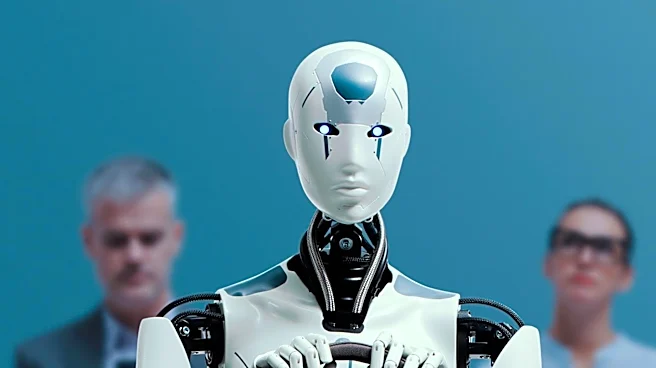
recognizing the emergence of AI agents capable of automating a significant portion of U.S. work hours, and utilizing AI capabilities to dynamically evaluate staffing needs. According to the McKinsey Global Institute, AI agents could automate up to 57% of U.S. work hours. Companies are now grappling with how to plan for a workforce that integrates both human and AI agent workers, defining their skills, tasks, permissions, and accountability. Rebecca Carr, president of HCM products at SAP, and David Wachtel, general manager of HCM products at Workday, emphasize the need for leaders to redesign work around better outcomes, rather than simply automating existing processes. This requires a detailed understanding of tasks within roles, the skills required, and where AI can augment or automate work, while ensuring human oversight and accountability remain paramount.
Why It's Important?
The integration of AI into workforce planning holds significant implications for U.S. businesses, impacting productivity, cost structures, and the nature of employment. Companies that effectively leverage AI in workforce management can optimize their human capital, reduce operational costs, and enhance overall business efficiency. This shift necessitates a closer collaboration between CIOs and CHROs, as technology decisions become inseparable from workforce strategy. CIOs play a crucial role in implementing the technological infrastructure for AI-driven workforce solutions, while CHROs must redefine roles, develop new skill sets, and manage the human-AI interface. The potential for AI to automate a large percentage of work hours could lead to significant workforce restructuring, requiring businesses to invest in reskilling and upskilling programs for their employees. Failure to adapt could result in decreased competitiveness, talent shortages in critical AI-related fields, and potential social challenges related to job displacement.
What's Next?
The future of workforce planning will increasingly involve managing AI agents as integral parts of the team, requiring clear definitions of their roles, boundaries, and accountability. Companies will need to develop operational playbooks for integrating AI agents into hybrid teams and adjust HR systems to account for both human and AI contributions. This means HR systems will evolve to track not just individuals and jobs, but also the specific tasks performed, the skills applied, and AI's contribution to outcomes. The relationship between CIOs and CHROs will become even more critical, as they jointly decide which work to redesign, what skills employees will need, and how to measure the success of these transformations. Expect continued development of AI-powered tools for skill tracking, workforce analytics, and dynamic job redefinition. Businesses will also need to establish robust governance frameworks for AI agents, ensuring they operate within company policies and ethical guidelines.
Beyond the Headlines
The profound shift in workforce dynamics due to AI extends beyond operational efficiencies, touching upon ethical considerations and the very definition of work. As AI agents take on more tasks, the focus for human workers will increasingly shift towards higher-value activities requiring creativity, critical thinking, and emotional intelligence. This could lead to a more specialized and intellectually demanding workforce, but also raises concerns about the future of jobs that are highly susceptible to automation. The ethical implications of managing AI agents as 'workers' will become more prominent, including questions about their rights, responsibilities, and the data they process. Furthermore, the need for continuous learning and adaptation will become paramount for individuals, as skill requirements evolve rapidly. This transformation could also exacerbate existing inequalities if access to AI training and high-value roles is not equitably distributed, necessitating policy discussions around education, social safety nets, and the future of employment in an AI-driven economy.