




What's Happening?
During a Council on Economic and Fiscal Policy meeting on November 11, Japanese Prime Minister Sanae Takaichi directed Economic and Fiscal Policy Minister Minoru Kiuchi to closely monitor financial and capital markets and take all necessary precautions
to ensure a stable macroeconomic environment. Takaichi also reiterated the government's policy of collaborating with the Bank of Japan to achieve price stability, in line with the Government-BOJ Joint Statement. Following the Bank of Japan's indication that it has broadly met its 2% inflation target, private-sector council members emphasized that the goal is not merely rising prices, but achieving a growth-oriented economy through a virtuous cycle of wages and prices. They highlighted risks such as overseas economies and AI investment trends, calling for flexible responses. The September core Consumer Price Index (CPI) rose 2.1% year-on-year, exceeding the target for the first time in nine months.
Why It's Important?
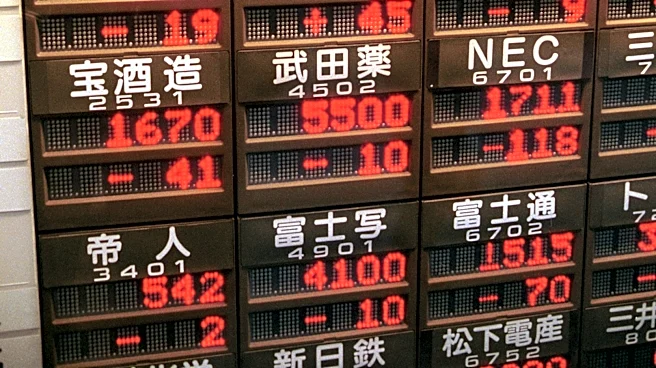
This directive from Prime Minister Takaichi underscores the Japanese government's proactive approach to economic management amidst global uncertainties. The instruction to closely monitor markets reflects concerns about potential volatility, particularly given the recent correction in U.S. AI-related stocks and its possible spillover effects on the real economy. Ensuring a stable macroeconomic environment is crucial for maintaining investor confidence, supporting business growth, and protecting household incomes. The emphasis on a virtuous cycle of wages and prices, rather than just inflation, indicates a focus on sustainable economic growth and improved living standards. For U.S. businesses and investors, Japan's commitment to market stability and growth-oriented policies can offer a predictable environment for trade and investment, while also providing insights into how other major economies are navigating post-pandemic recovery and technological shifts.
What's Next?
Economic and Fiscal Policy Minister Kiuchi will be tasked with closely monitoring the interaction between the real economy and financial markets, particularly in response to global economic shifts and AI investment trends. The government and the Bank of Japan will continue their coordinated efforts to achieve price stability and foster sustainable economic growth. The private-sector council members' call for flexible responses suggests that the administration may consider various policy tools to address emerging risks and ensure the entrenchment of a growth path beyond the inflation target. Market participants will be closely watching the government's response during any stock market corrections and its overall approach to policy coordination with the Bank of Japan.
Beyond the Headlines
The Prime Minister's directive highlights a sophisticated understanding of the interconnectedness of global financial markets and domestic economic stability. The mention of AI investment trends as a risk factor points to the evolving nature of economic vulnerabilities, where technological advancements can create both opportunities and systemic risks. This situation prompts a deeper reflection on how governments can effectively manage the economic implications of rapid technological change and global market fluctuations. The focus on a 'virtuous cycle of wages and prices' also speaks to the broader challenge of achieving inclusive economic growth, where the benefits of prosperity are widely shared. This approach contrasts with purely inflation-targeting strategies, suggesting a more holistic view of economic well-being. The long-term implications could include a re-evaluation of traditional economic indicators and the development of more adaptive policy frameworks to address complex, modern economic challenges.