









What's Happening?
Venus Aerospace, a startup specializing in rocket engine technology, has successfully raised $91 million in a Series B funding round. The investment was led by Mercury Fund, with significant participation from Lockheed Martin Ventures. The funding aims
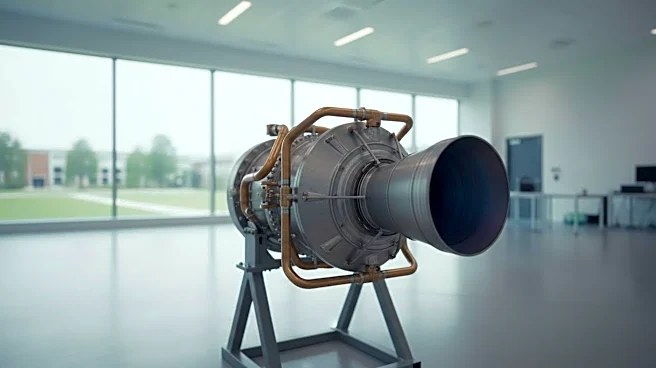
to support the development and production of Venus Aerospace's rotating detonation rocket engine, which promises enhanced efficiency and speed over traditional rocket motors. The company is focused on scaling its operations to meet both commercial and government demands, including increasing its manufacturing capacity and hiring additional technical and business talent. The startup, based in Houston, has already completed a successful test flight of its engine, which utilizes a continuous supersonic combustion process and is constructed from 3D-printed components.
Why It's Important?
The investment in Venus Aerospace comes at a critical time as the U.S. government pressures defense contractors to accelerate production amid supply chain challenges and increased demand for advanced propulsion systems. The company's innovative engine technology could significantly enhance the performance of munitions and space vehicles, offering a potential solution to current limitations in solid rocket motor technology. This development is particularly relevant as geopolitical tensions drive the need for more efficient and capable defense systems. The success of Venus Aerospace could lead to a transformative shift in the defense and aerospace industries, potentially reducing costs and increasing payload capacities for space missions.
What's Next?
Venus Aerospace plans to expand its workforce and manufacturing capabilities to meet the anticipated demand for its propulsion systems. The company is also expected to make further announcements regarding its production timelines and targets. As the defense industry continues to evolve, Venus Aerospace's technology could play a pivotal role in future military and space operations. The startup's ability to quickly test and integrate changes to its engines will be crucial in maintaining its competitive edge and meeting the needs of defense programs.