


What's Happening?
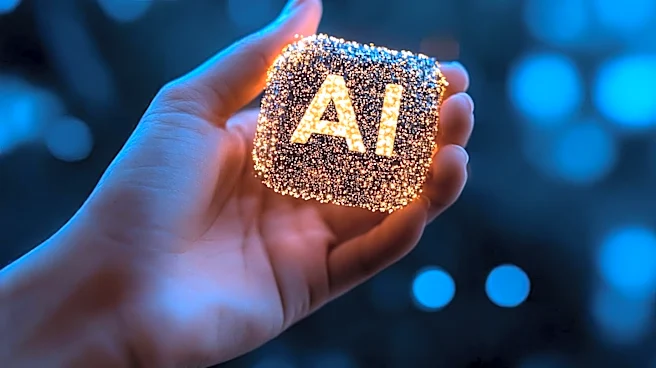
Economist Nouriel Roubini, CEO of Roubini Macro Associates, has projected that artificial intelligence could lead to a dramatic increase in US economic growth to 10% annually by 2050, up from the current 2%. However, this growth could come with a significant
trade-off: unemployment rates potentially soaring as high as 80%. Roubini, known as 'Dr. Doom' for his accurate prediction of the 2008 financial crisis, shared these insights in a November 17 interview with Bloomberg. He emphasized that while AI could drive substantial economic expansion, the benefits might be unevenly distributed, leading to 'massive inequality.' Technology companies and highly skilled professionals are expected to capture a disproportionate share of these gains, leaving less-skilled workers vulnerable to job displacement. This forecast highlights a potential future where technological advancement profoundly reshapes the labor market.
Why It's Important?
Roubini's forecast underscores a critical debate about the future of work and economic equity in the United States. If AI indeed leads to 80% unemployment, it would necessitate a fundamental rethinking of economic and social structures. The potential for 'massive inequality' suggests that the economic benefits of AI might not trickle down to the majority of the population, exacerbating existing wealth disparities. This scenario could place immense pressure on public policy to address widespread job displacement and ensure economic stability for a large segment of the population. The discussion around universal basic income (UBI), universal healthcare, and universal inheritance as potential solutions gains significant urgency in this context, as these policies aim to redistribute wealth and provide a safety net in an economy where traditional employment may no longer be the norm. The implications extend to various sectors, as businesses would need to adapt to a vastly different consumer base and labor pool.
What's Next?
In response to potential widespread job displacement, Roubini suggests that governments may need to implement expanded wealth redistribution policies. These could include universal basic income (UBI), initially through means testing and eventually on a universal basis, as well as universal healthcare and universal inheritance. These policy options aim to provide economic support and address access to wealth and healthcare in an economy where technology owners could capture an increasing share of economic gains. While economists hold differing views on the role and impact of UBI, Roubini's projections suggest that such measures might become essential to prevent societal instability. The ongoing development and adoption of AI technologies will likely continue to influence job markets, prompting further discussions among policymakers, businesses, and labor organizations about how to prepare for and mitigate the potential negative consequences of automation.
Beyond the Headlines
The deeper implications of Roubini's predictions extend beyond immediate economic shifts, touching upon fundamental societal structures and ethical considerations. A future with 80% unemployment could challenge the very definition of work, purpose, and social contribution in American society. It raises questions about how individuals will derive meaning and engage with their communities if traditional employment is no longer a primary pathway. Ethically, the concentration of wealth and power in the hands of a few technology companies and highly skilled individuals could lead to significant social unrest and calls for more radical economic restructuring. Legally, new frameworks might be required to manage intellectual property rights related to AI-generated output and to ensure fair distribution of AI-driven productivity gains. Culturally, society might need to adapt to a paradigm where leisure and non-traditional forms of contribution become more central, potentially altering educational systems, social welfare programs, and even urban planning to accommodate a largely non-working population.