







What's Happening?
Cal Poly Pomona's Ethnomusicology Professor Jessie Vallejo has designed an unconventional music course, MU 4171W: Theory, History, and Design of Musical Instruments, which emphasizes 'Learn By Doing.' The course challenges students to create functional
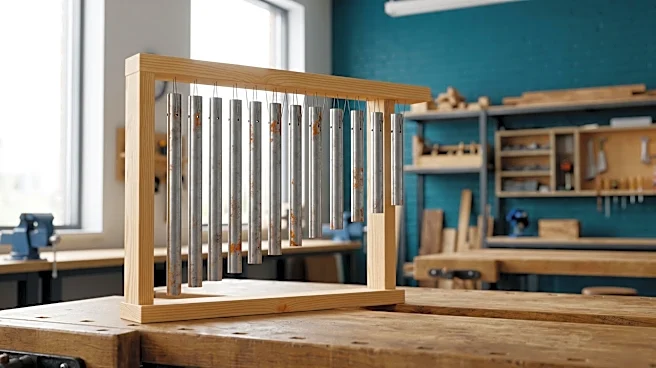
musical instruments from upcycled materials, blending creativity, engineering, and sustainability. One notable project involved a student transforming metal tubes from a junkyard, originally intended for basketball hoops, into chimes. Additionally, the curriculum includes an 'AI Frankenstein Instrument' challenge where students follow AI-generated instructions to build instruments, highlighting the limitations of AI in creative fields. The class also collaborates with Innovation Orchard, providing students access to woodworking tools and mentors to construct experimental idiophones like daxophones. This hands-on approach aims to engage students from various majors and musical proficiency levels, fostering a multidisciplinary learning environment.
Why It's Important?
This innovative course at Cal Poly Pomona is significant for several reasons. Firstly, it promotes sustainability by encouraging students to repurpose discarded materials into functional instruments, thereby reducing waste and fostering an eco-conscious mindset within the arts. Secondly, the integration of AI into the curriculum offers a critical perspective on technology's role in creative processes, demonstrating both its potential and its current limitations. This prepares students for a future where human creativity and artificial intelligence will increasingly interact. Thirdly, by making the course accessible to non-music majors and emphasizing hands-on creation, it broadens participation in music education and instrument design, potentially inspiring new forms of artistic expression and interdisciplinary collaboration. The course also serves as a tribute to Professor Vallejo's late father, highlighting the personal connection between craftsmanship, family legacy, and education.
What's Next?
Professor Vallejo plans to continue offering MU 4171W to juniors and seniors in Fall 2027, aiming to further expand its multidisciplinary reach. She hopes to construct soundboxes for the daxophones created in class, with the long-term vision of assembling a permanent departmental instrument for recording and use by Cal Poly Pomona's New Music and Electronic Music ensembles. This initiative could lead to unique musical performances and compositions featuring these student-designed instruments. Vallejo also anticipates increased collaboration with other professors and departments, fostering a more integrated approach to arts and technology education. The ongoing success of this course could serve as a model for other institutions looking to incorporate sustainability, interdisciplinary learning, and critical engagement with technology into their arts programs.
Beyond the Headlines
The course's emphasis on upcycling and AI in instrument design touches upon deeper societal and ethical considerations. The act of transforming 'garbage' into musical instruments challenges conventional notions of value and waste, promoting a circular economy mindset within creative practices. The 'AI Frankenstein Instrument' project, while humorous, subtly critiques the uncritical adoption of AI, prompting students to understand its current boundaries in complex creative tasks. This fosters a more nuanced understanding of human-AI collaboration, where human ingenuity remains paramount in guiding and refining technological outputs. Furthermore, the course's personal inspiration, rooted in Professor Vallejo's desire to honor her father's craftsmanship, underscores the enduring human need for hands-on creation and the transmission of practical skills across generations, even in an increasingly digital world. It highlights how education can bridge personal narratives with broader societal challenges.