





What's Happening?
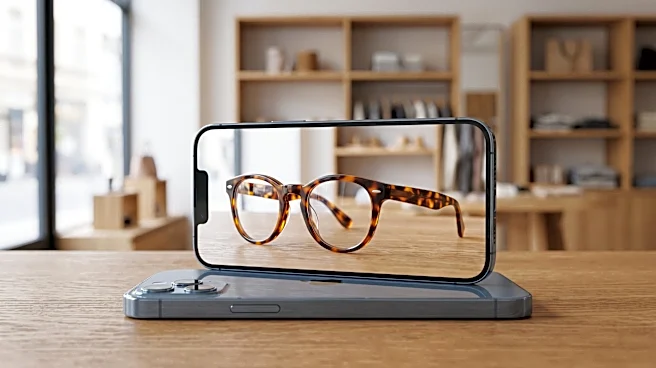
Retailers across various sectors, including eyewear, jewelry, and e-commerce clothing, are increasingly implementing augmented reality (AR) fitting rooms. This technology allows customers to virtually try on products without the need for physical changing.
AR try-on solutions offer an interactive and cost-effective way for businesses to engage consumers, both in-store and online. Companies like Warby Parker, Sephora, Walmart, ASOS, and Zara have integrated AR into their shopping experiences. The core of AR technology involves overlaying digital information, such as 3D models of products, onto a user's real-world view through devices like smartphones or interactive screens. This innovation aims to streamline the shopping process, making it more convenient for customers to visualize how items look on them before making a purchase. Advanced solutions are evolving from basic AR to AI live try-on, which uses AI visual generation and real-time deformation to create more realistic virtual fitting experiences by capturing body contours and movements and reconstructing clothing details.
Why It's Important?
The adoption of AR fitting rooms is significant for the U.S. retail industry as it addresses several long-standing challenges. For consumers, it eliminates the inconvenience of long fitting room queues and the repetitive process of changing clothes, thereby improving the overall shopping experience and potentially reducing buyer's remorse. For retailers, this technology is a powerful tool to drive sales by increasing try-on efficiency and customer engagement. It also helps to overcome physical space limitations by allowing stores to display their entire product catalog virtually. Crucially, AR fitting rooms are proving effective in reducing high return rates in online retail, a major financial drain for e-commerce businesses. By enabling customers to accurately preview products, retailers can minimize returns caused by sizing or style mismatches, leading to significant cost savings and improved customer satisfaction. This technological shift is reshaping how consumers interact with products and how retailers manage inventory and customer service.
What's Next?
The trend of integrating AR and AI into retail is expected to continue expanding, with further advancements in realism and accessibility. As AR technology becomes more sophisticated, the virtual try-on experience will likely become even more seamless and indistinguishable from physical try-ons. We can anticipate more brands, including smaller businesses, adopting these solutions as the technology becomes more affordable and easier to implement. Future developments may include more personalized virtual fitting experiences, where AI can recommend sizes and styles based on individual body measurements and preferences. The integration of AR with other emerging technologies, such as virtual reality (VR) and the metaverse, could also create entirely new shopping environments. Retailers will likely focus on refining the accuracy of virtual representations and enhancing the interactive elements to keep customers engaged and drive conversion rates higher. The ongoing evolution of AR in retail suggests a future where the lines between online and in-store shopping experiences become increasingly blurred.
Beyond the Headlines
Beyond the immediate benefits of convenience and reduced returns, the widespread adoption of AR fitting rooms signals a deeper transformation in consumer behavior and retail strategy. This technology fosters a more personalized and interactive shopping journey, potentially increasing brand loyalty and customer engagement in an increasingly competitive market. Ethically, it raises questions about data privacy, as these systems collect detailed information about body shapes and preferences, necessitating robust data protection measures. Legally, there may be evolving standards for how biometric data is collected and used in retail settings. Culturally, it represents a shift towards a more digital-first approach to consumption, where virtual experiences become as influential as physical ones. In the long term, this could lead to a reduction in physical retail footprints, a greater emphasis on digital product development, and a redefinition of the role of brick-and-mortar stores, potentially transforming them into experiential hubs rather than just transaction points. The environmental impact could also be significant, as reduced returns mean less shipping and waste.