





What's Happening?
Lahontan Gold (TSX-V:LG) has announced three new appointments to its management team as it progresses plans to restart its Santa Fe Mine in Nevada. Tony Gesualdo has been appointed Vice President – Exploration, Michael Kubel as Senior Mine Engineer, and
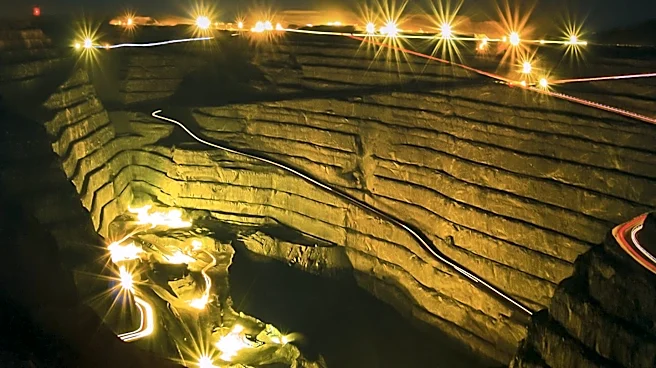
Jen Earle will lead Investor Relations & Business Development. Gesualdo, who previously served as exploration manager for Lahontan from 2020 to 2023, returns to the company with experience from other gold miners like Coeur Mining, OceanaGold, and Barrick Mining. Kubel brings over a decade of experience in Nevada open-pit gold mining and heap-leach processing, including work at the Florida Canyon and Hycroft mines. Earle has 20 years of experience in the natural resources sector. These appointments are part of Lahontan Gold's strategy to build the necessary technical, operational, and business development capabilities to advance the Santa Fe Mine towards production, with a target restart in 2027. The Santa Fe Mine, located in Nevada's Walker Lane, is a former open-pit, heap-leach gold and silver mine that produced significant quantities of gold and silver between 1988 and 1995.
Why It's Important?
The strengthening of Lahontan Gold's management team is a critical step in advancing the Santa Fe Mine restart, which holds significant importance for the U.S. mining industry and the Nevada economy. The Santa Fe Mine, a former producer, represents a valuable domestic source of gold and silver. Its restart would contribute to U.S. mineral production, potentially reducing reliance on foreign sources and enhancing national economic security. The appointments of experienced professionals like Gesualdo, Kubel, and Earle indicate a serious commitment to technical excellence and strategic development, which are essential for successful mine operations. The company's assembly of a 28km² land position encompassing historic pits and heap-leach pads, coupled with an expanded resource base of nearly 1.2 million ounces of gold equivalent in the indicated category, underscores the project's economic potential. A 2024 preliminary economic assessment (PEA) outlined an eight-year operation producing approximately 345,000 ounces of gold equivalent, which would generate substantial revenue and create jobs in Nevada. This development is a positive indicator for the U.S. mining sector, demonstrating continued investment and growth in domestic resource extraction.
What's Next?
Lahontan Gold is actively pursuing a phased development strategy for the Santa Fe Mine, initially targeting shallow oxide material before potentially incorporating the project's larger sulphide resource. Permitting for the Phase One oxide development is currently underway. The company is also preparing a new preliminary economic assessment (PEA) to evaluate the expanded resource base and higher-grade sulphide mineralization, which will provide a more comprehensive economic outlook for the project. The ultimate goal is to begin construction in 2027, leading to the restart of production. The newly appointed management team will play a crucial role in overseeing these stages, from exploration and engineering to investor relations and business development. Their collective expertise will be vital in navigating the technical challenges, regulatory requirements, and financial aspects of bringing a former mine back into operation. The success of these efforts will determine the timeline and scale of the Santa Fe Mine's contribution to gold and silver production in the U.S. and its impact on the local economy.
Beyond the Headlines
The restart of the Santa Fe Mine by Lahontan Gold carries broader implications for the U.S. mining landscape and resource policy. The project's focus on a former mine highlights a growing trend in the industry to re-evaluate and re-develop previously exploited sites, leveraging new technologies and higher commodity prices to extract remaining resources. This approach can be more environmentally sustainable than developing entirely new greenfield sites, as it utilizes existing infrastructure and minimizes new land disturbance. However, it also necessitates careful management of legacy environmental issues. The project's location in Nevada's Walker Lane, a historically prolific mining region, underscores the state's continued importance as a hub for precious metals production in the U.S. This could reinforce Nevada's role in national mineral supply chains and attract further investment into the region. Furthermore, the emphasis on building a strong technical and operational team reflects the increasing complexity and capital intensity of modern mining, requiring specialized expertise across various disciplines. The long-term success of such projects will depend not only on geological potential and market conditions but also on effective community engagement, regulatory compliance, and the adoption of best practices in environmental and social governance.