


What's Happening?
Josh Hash from the Strength Side YouTube channel has developed 12 bodyweight fitness tests designed to assess and improve an individual's relative strength from home. These tests progress in difficulty, starting with foundational movements like push-ups
and squats, and advancing to more challenging exercises such as pull-ups, pistol squats, and handstand push-ups. The tests are organized into clusters, with each cluster focusing on a 'push, squat, and pull' movement pattern. Hash emphasizes that these tests can also serve as a training plan, allowing individuals to identify their current strength levels and work towards specific goals. The program is presented as accessible for parents but is relevant for anyone seeking to challenge themselves and improve bodyweight strength.
Why It's Important?
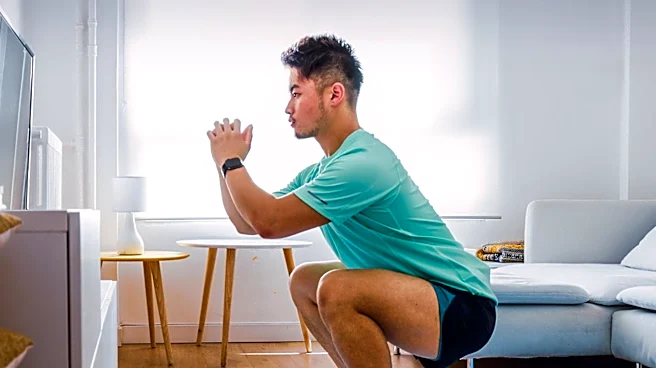
The availability of structured at-home bodyweight strength tests is significant for promoting physical fitness and health without requiring gym access or specialized equipment. This approach democratizes strength training, making it more accessible to a wider population, including those with limited time, financial resources, or proximity to fitness facilities. By providing clear benchmarks and a progressive training plan, individuals can track their progress and maintain motivation. This can lead to improved overall physical health, increased mobility, and better joint health, as highlighted by the emphasis on foundational movements like squats. The focus on bodyweight exercises also reduces the risk of injury often associated with heavy lifting, making it a safer option for many.
What's Next?
Individuals can begin by assessing their current strength levels using the foundational tests, such as push-ups (benchmark: 25 reps) and squats (benchmark: 100 reps). Once a baseline is established, they can progressively work through the more advanced clusters, focusing on proper form to maximize effectiveness and prevent injury. The program suggests training the clusters of three movements together before advancing. Continued practice and adherence to the benchmarks will lead to improved strength and body control. The long-term goal is to achieve higher levels of bodyweight mastery, which can translate to better functional strength for daily activities and other physical pursuits.
Beyond the Headlines
The development of comprehensive bodyweight strength tests like these highlights a growing trend towards functional fitness and accessible exercise solutions. In an increasingly busy world, the ability to maintain physical health without external dependencies becomes crucial. This approach also subtly shifts the focus from aesthetic-driven fitness to performance-based strength, emphasizing what the body can do rather than just how it looks. Furthermore, the concept of 'relative strength'—how well one can move their own bodyweight—is a fundamental aspect of human movement and can have profound long-term benefits for mobility and independence as individuals age. This method encourages self-reliance and a deeper understanding of one's own physical capabilities.