




What's Happening?
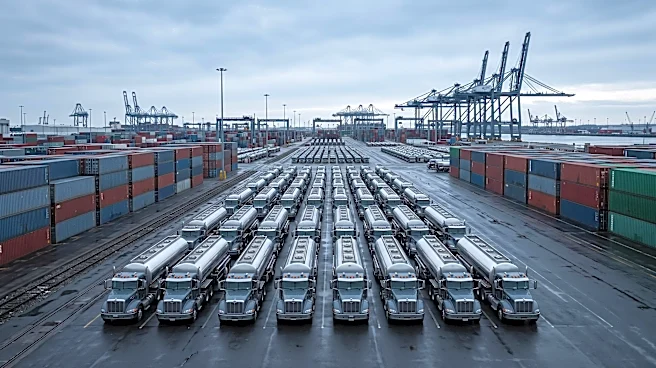
U.S. authorities have sanctioned two Mexican business owners and seven companies for their alleged role in facilitating a cross-border fuel smuggling network for the Cartel Jalisco Nueva Generación (CJNG). The Office of Foreign Assets Control (OFAC) targeted
these individuals and entities in June, designating them for providing material and financial assistance to the cartel. The sanctioned companies included a financial services firm, freight and transportation companies, and a real estate company, all controlled by the same individual. Prior to the June 30 action, none of the sanctioned individuals or companies were on OFAC’s specially designated nationals and blocked persons list. This action highlights a growing concern that criminal networks are increasingly utilizing legitimate commercial structures and supply chains to conduct illicit activities, making traditional due diligence methods insufficient.
Why It's Important?
This development is important for U.S. businesses operating in or with exposure to high-risk sectors in Mexico. The sanctions underscore the evolving landscape of risk, where criminal organizations are embedding themselves within seemingly legitimate commercial operations. Traditional Know Your Client (KYC) checks, primarily focused on sanctions and watchlist screening, may no longer be adequate to identify these hidden facilitators. The designation of Mexican cartels as foreign terrorist organizations (FTOs) last year further elevates the legal, regulatory, and reputational risks for companies. Businesses must now adopt a more comprehensive, risk-based approach that scrutinizes beneficial ownership, regulatory authorizations, and broader supply chain connections to identify potential liabilities before they become enforcement issues. Failure to do so could result in significant penalties and reputational damage.
What's Next?
Companies conducting business in Mexico will likely need to enhance their due diligence practices beyond standard sanctions screening. This will involve a deeper investigation into beneficial ownership structures, potentially requiring the piecing together of corporate records across multiple jurisdictions and identifying common shareholders or controllers. Furthermore, businesses will need to understand Mexico's fragmented regulatory framework and be familiar with the specific authorities overseeing each industry to ensure their counterparties are operating within their authorized bounds. The U.S. government is expected to continue its efforts to disrupt criminal networks by targeting their financial facilitators, which will necessitate ongoing vigilance and adaptation by companies to avoid inadvertent involvement in illicit activities.
Beyond the Headlines
The case reveals a fundamental limitation of traditional due diligence, which is effective at identifying already designated entities but less so at uncovering hidden commercial networks and facilitators. This situation raises ethical and legal questions about corporate responsibility in high-risk environments. Companies are now faced with the challenge of proactively identifying potential illicit connections, even when those connections are deliberately obscured through complex ownership structures and diverse industry operations. The increased scrutiny on beneficial ownership could lead to a broader shift in global compliance standards, pushing for greater transparency in corporate structures to combat money laundering, terrorism financing, and other illicit activities. This also highlights the tension between national sovereignty and international efforts to combat transnational crime, as Mexico's corporate information is often decentralized and difficult to access comprehensively.