





What's Happening?
Combat Fitness, a tactical fitness program provider, recommends incorporating landmine exercises into core training routines, particularly for athletes, soldiers, operators, and first responders. The program suggests training core with the landmine twice
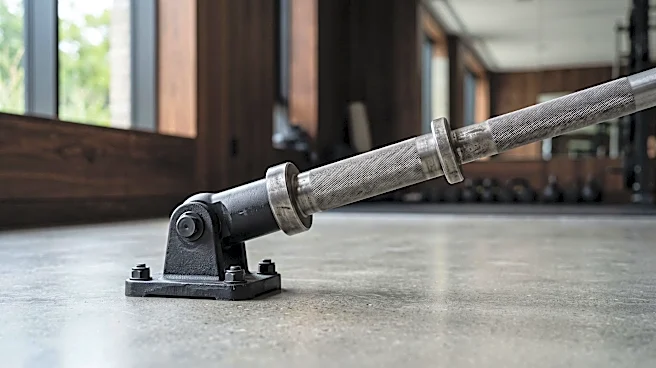
a week, either after main lifts or on a conditioning day, to develop a 'tactical trunk.' Key exercises highlighted include standing landmine rotation, landmine anti-rotation hold, half-kneeling landmine rotation, and landmine oblique twist. These exercises are designed to train the trunk to both generate and resist rotational force, mirroring movements required in various physically demanding professions. The landmine's anchored bar allows for heavy loading of rotation and anti-rotation without the weight drifting, and its arc movement simulates force transfer in activities like throwing or swinging. The emphasis is on controlled movements, turning from the hips and upper back, and pivoting the feet to protect the lumbar spine.
Why It's Important?
This approach to core training is important for individuals in professions requiring high levels of functional strength and injury prevention, such as military personnel and first responders. By focusing on rotation and anti-rotation, landmine exercises build a core that can effectively transfer force between the legs and arms, crucial for tasks like carrying heavy loads, breaching doors, or engaging in combatives. The methodology aims to reduce musculoskeletal injuries, which are a significant concern for Army readiness, by developing a durable trunk. The controlled nature of landmine exercises also helps in protecting the lumbar spine, a common area for injury, by ensuring proper biomechanics during rotational movements. This training philosophy prioritizes functional strength over isolated core work, recognizing that a strong core's primary role is to facilitate force transfer and stability in dynamic, real-world scenarios.
What's Next?
Individuals interested in implementing this training can integrate the recommended landmine core workout into their existing fitness routines. Combat Fitness suggests running the circuit twice a week as a 'finisher' after main lifts or on a conditioning day. The program advises starting with an empty bar and gradually increasing load or hold duration once proper form is mastered. For those seeking a structured plan, Combat Fitness offers guides on choosing strength and endurance programs that incorporate these principles. The focus will likely remain on refining technique and progressively overloading the exercises to continue building rotational and anti-rotational strength, with an emphasis on control over speed to prevent injury.
Beyond the Headlines
The emphasis on functional core strength, particularly rotation and anti-rotation, reflects a broader shift in fitness philosophy towards training movements rather than isolated muscles. This approach acknowledges that the core's role extends beyond aesthetics to critical functions like force transmission and injury prevention in dynamic activities. The use of landmine exercises, which provide a fixed arc of motion, offers a safer and more controlled way to load rotational movements compared to free weights, making it accessible for a wider range of individuals, including those recovering from injuries or new to functional training. This methodology could influence how core training is designed in various athletic and occupational settings, promoting more effective and injury-resilient physical conditioning.