





What's Happening?
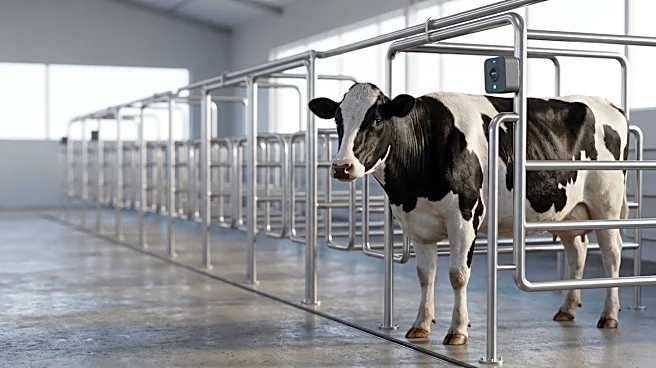
Herd-i, a company specializing in artificial intelligence, is introducing a new AI-powered system to U.S. dairy producers aimed at improving herd health and management. This technology utilizes in-parlor cameras to capture images of every cow after milking,
providing daily body condition scores. According to Nicole Mozeliak, U.S. CEO for Herd-i, the system reports these scores to a customizable dashboard, enabling producers to make informed decisions regarding their herd's productivity and well-being. The AI-driven approach eliminates human eye fatigue and subjectivity, offering reliable and objective data for herd management. The system was initially launched in New Zealand in 2021 and currently monitors over 145,000 cows daily. Herd-i is actively seeking 25 U.S. producers to participate in its 'Founding Farmers' program, allowing them to be among the first to implement this platform in the United States.
Why It's Important?
This new AI system holds significant importance for the U.S. dairy industry by offering a technological solution to enhance efficiency and animal welfare. By providing objective and consistent daily body condition scores, dairy producers can proactively identify and address health issues in individual cows, potentially leading to improved milk production, reduced veterinary costs, and better overall herd health. The labor-saving aspect of the technology is also crucial, as it can help mitigate challenges related to labor shortages in the agricultural sector. The adoption of such AI tools could set a new standard for precision livestock farming, allowing U.S. dairy farms to operate more sustainably and profitably. This innovation could also influence consumer confidence by demonstrating a commitment to animal well-being through advanced monitoring systems.
What's Next?
Herd-i is currently recruiting 25 U.S. dairy producers to join its 'Founding Farmers' program. This initiative will serve as the initial rollout of the AI-powered system in the United States, providing valuable feedback and demonstrating its efficacy in diverse farming environments. Following this pilot phase, the company is expected to expand its availability to a broader range of dairy producers across the country. The success of this program could lead to wider adoption of AI and computer vision technologies in the U.S. livestock industry, potentially inspiring other companies to develop similar solutions for various aspects of animal agriculture. Future developments may include integrating additional AI capabilities, such as disease detection and yield prediction, further revolutionizing herd management practices.
Beyond the Headlines
The introduction of AI for livestock behavior recognition, particularly in dairy farming, signifies a broader shift towards data-driven decision-making in agriculture. This technology not only optimizes operational efficiency but also raises ethical considerations regarding animal welfare. The objective monitoring provided by AI can lead to more consistent and humane treatment of animals, as health issues can be detected earlier and interventions can be more precise. However, it also prompts discussions about the balance between technological advancement and traditional farming practices, and the potential impact on the role of human labor in agriculture. The increasing reliance on AI in such critical sectors underscores the need for robust data privacy and security measures, as well as transparent algorithms to ensure fairness and accuracy in animal assessment.