






What's Happening?
The El Paso Chamber is urging local, state, and federal officials to reconsider the plan to remove commercial truck traffic from the Bridge of the Americas (BOTA) as part of its modernization project. This call comes after an independent study commissioned
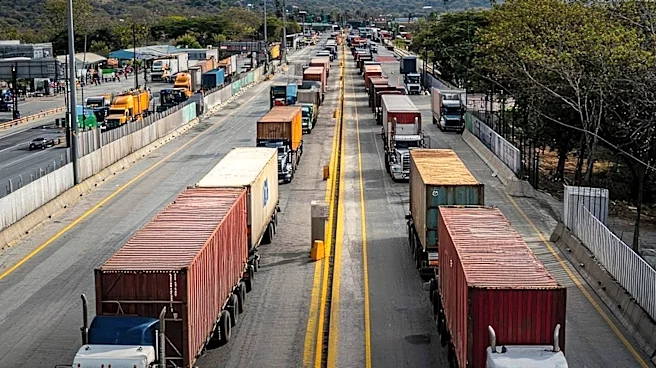
by the Chamber from the Hunt Institute for Global Competitiveness at the University of Texas at El Paso. The study projects significant negative economic consequences, including a $2.3 billion reduction in economic output, a loss of 9,529 job-years, and $600.7 million in lost labor income in El Paso County between 2028 and 2036. Additionally, it forecasts $213.1 million in combined federal, state, and county tax revenue losses and a 10.9% reduction in commercial trade, with forgone truck trade potentially reaching $36.6 billion in 2036 alone. U.S. Rep. Veronica Escobar (D-El Paso) acknowledged the study but stated that the decision to remove commercial traffic is final and that the General Services Administration (GSA) is already in the bidding process for the project.
Why It's Important?
This dispute highlights a significant conflict between local economic interests and federal infrastructure development plans. The El Paso Chamber's study underscores the potential for substantial economic disruption in the Paso del Norte region, a critical cross-border trade hub. The projected losses in economic output, jobs, and tax revenue could severely impact the local economy and the livelihoods of residents. Furthermore, the study suggests that shifting commercial traffic to other ports could strain existing infrastructure, increase cross-border wait times, and raise logistics costs, potentially hindering regional competitiveness. While the plan aims to address air and noise pollution for residents near BOTA, the economic trade-offs are considerable, affecting businesses, workers, and government revenue. This situation exemplifies the complex challenges of balancing environmental concerns, community well-being, and economic vitality in border regions.
What's Next?
Despite the El Paso Chamber's opposition and the findings of its study, U.S. Rep. Veronica Escobar has indicated that the decision to remove commercial traffic from BOTA is final, with the GSA proceeding with the bidding process for the project. Construction is expected to begin in early 2028. Escobar has urged the Chamber to focus its efforts on preparing other land ports of entry for the shift in traffic and to foster private-public partnerships for more innovative and efficient crossings. The Chamber, however, is calling for a pause in implementation and a reevaluation of alternatives. This suggests a continued push-and-pull between local business interests and federal agencies, with the project likely moving forward as planned, but with ongoing calls for mitigation strategies and support for affected businesses and communities.
Beyond the Headlines
The debate over the BOTA modernization project reveals deeper issues concerning urban planning, environmental justice, and economic development in border communities. While the removal of commercial traffic aims to alleviate pollution and improve quality of life for residents living near the port, it simultaneously poses a threat to the economic engine of the region. This situation forces a critical examination of how infrastructure projects are planned and implemented, and whether the social and environmental benefits for one segment of the population are adequately weighed against the economic impact on another. It also highlights the need for comprehensive regional planning that considers the interconnectedness of border economies and the potential ripple effects of policy decisions. The outcome of this project could serve as a case study for future urban development initiatives in other U.S. border cities facing similar challenges.