







What's Happening?
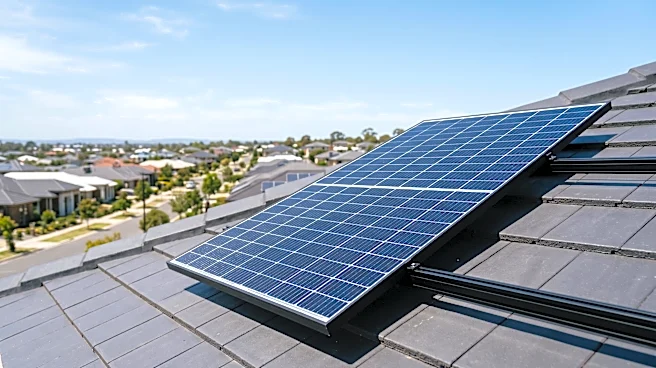
Pasadena Water and Power (PWP) is providing financial incentives for eligible commercial electric customers to install new rooftop solar photovoltaic (PV) systems and battery storage solutions. For commercial solar installations, PWP offers $0.40 per
watt, with a maximum incentive of $80,000 per meter. Separately, a Commercial Battery Storage Rebate Program provides $225 per kilowatt-hour (kWh) for the initial 200 kWh of battery capacity and $100 per kWh for additional capacity, also capped at $80,000 per meter. To qualify, solar and battery systems must be customer-owned, installed by a licensed C-10 electrical contractor, and meet PWP's interconnection requirements. Leased systems and projects financed through Power Purchase Agreements (PPAs) are not eligible. Additionally, PWP is temporarily waiving certain plan review and inspection fees for solar and battery systems, and eligible systems must be installed on or after January 1, 2026.
Why It's Important?
These incentives from Pasadena Water and Power are significant for businesses within its service area, as they aim to reduce the upfront costs associated with adopting renewable energy and energy storage technologies. By offering substantial rebates, PWP is making commercial solar and battery storage more financially attractive, potentially accelerating the transition to cleaner energy sources and enhancing energy resilience for local businesses. The requirement for customer ownership ensures that the long-term benefits, such as reduced electricity bills and federal tax credits, accrue directly to the businesses. This initiative could stimulate local economic activity by increasing demand for licensed electrical contractors and renewable energy equipment, while also contributing to broader environmental goals by promoting sustainable energy practices.
What's Next?
Businesses in Pasadena considering commercial solar or battery energy storage are encouraged to evaluate these incentives, as they could significantly alter the economic viability of such projects. The first step for interested parties will be to confirm their eligibility with PWP and then assess how the incentives align with their project costs and anticipated energy savings. The January 1, 2026, installation eligibility date suggests a forward-looking approach, allowing businesses time to plan and implement projects. The temporary waiver of plan review and inspection fees further reduces initial barriers, indicating a concerted effort by PWP to encourage rapid adoption of these technologies. The program's success could lead to continued or expanded incentives in the future, depending on uptake and impact.
Beyond the Headlines
The PWP incentives highlight a growing trend among local utilities to encourage distributed energy resources, which can help stabilize the grid, reduce peak demand, and contribute to local energy independence. By focusing on commercial customers, PWP is targeting entities with significant energy consumption, where the impact of solar and storage can be substantial. This approach also aligns with broader national efforts to decarbonize the energy sector and build a more resilient energy infrastructure. The emphasis on customer-owned systems reflects a policy choice that empowers businesses to take direct control of their energy production and consumption, fostering a more decentralized and sustainable energy landscape. Such local initiatives often serve as models for other municipalities looking to advance their clean energy goals.