


What's Happening?
Brie Larson's character, Captain Marvel, was unexpectedly featured in The Walt Disney Company's recent quarterly earnings report, appearing in an icon representing the Avengers franchise. This inclusion comes despite 'The Marvels,' the character's 2023
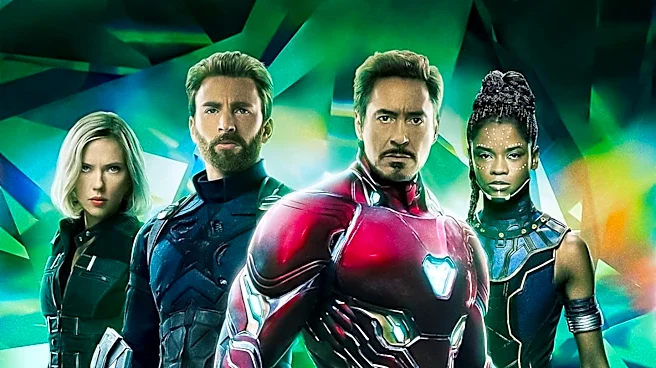
film, becoming the lowest-grossing movie in the Marvel Cinematic Universe, earning only $206.6 million globally and failing to recoup its budget. The icon in the report depicted Captain Marvel alongside other prominent Avengers like Captain America, Iron Man, Thor, and Hulk, all from promotional artwork for 'Avengers: Endgame.' This appearance is considered significant because Disney could have chosen to exclude her or replace her with another character, such as Paul Rudd's Ant-Man, who is confirmed for 'Doomsday.' The decision to include Captain Marvel suggests that Disney may not have entirely lost faith in the character, despite the previous box-office disappointment. Furthermore, it was announced earlier this year that Brie Larson will reprise her role as Carol Danvers in the Stark Flight Lab flight simulator ride at the Avengers Campus Expansion in Disney California Adventure, set to open in 2028.
Why It's Important?
The inclusion of Brie Larson's Captain Marvel in Disney's earnings report holds significant implications for the future of the character within the Marvel Cinematic Universe and for Disney's strategic approach to its intellectual properties. For investors and shareholders, this could signal Disney's long-term commitment to the character, potentially mitigating concerns that 'The Marvels' box office performance would lead to her abandonment. If Disney were to completely sideline Captain Marvel, it could be perceived as a reactive measure to a single film's underperformance, potentially devaluing a major character in their expansive franchise. By keeping her visible, Disney might be aiming to maintain brand continuity and explore new narrative avenues for the character, rather than discarding a known entity. This strategy could also influence how other studios handle characters whose standalone films underperform, suggesting a more patient and long-term view of franchise development. The decision to feature her in the upcoming Disney California Adventure ride further reinforces this commitment, indicating that the character still holds value for theme park attractions and broader brand engagement.
What's Next?
The future of Brie Larson's Captain Marvel in the MCU remains a subject of speculation, but recent developments suggest a continued presence. While her role in the upcoming 'Doomsday' film is unconfirmed, Larson's non-denial when asked about her appearance indicates a possibility, potentially in a smaller capacity to avoid overshadowing the main narrative, similar to her role in 'Endgame.' Looking further ahead, there's a chance for a more substantial role in 'Avengers: Secret Wars,' especially given her character's significance in the comics during the destruction of Earth-616 and her involvement in the all-female superhero team A-Force. Marvel Studios may seek to reinvent the character, much like they did with Thor after 'Thor: The Dark World,' to re-engage audiences. This could involve pairing her with younger heroes like Kamala Khan to address the Multiverse's challenges. The confirmed return of Larson as Carol Danvers in the Stark Flight Lab ride at Disney California Adventure in 2028 further solidifies Disney's ongoing investment in the character, irrespective of past film performance.
Beyond the Headlines
The continued presence of Brie Larson's Captain Marvel in Disney's strategic communications, despite 'The Marvels' being a box-office disappointment, highlights a deeper industry trend regarding franchise management and intellectual property valuation. In an era dominated by interconnected cinematic universes, the long-term value of a character often transcends the performance of a single film. Studios like Disney are increasingly focused on building enduring franchises that can generate revenue across multiple platforms, including theme parks, merchandise, and streaming services, in addition to theatrical releases. This approach suggests that a character's 'failure' in one medium does not necessarily equate to their overall obsolescence. Instead, it can prompt a re-evaluation of narrative direction and character development to better align with audience expectations and broader franchise goals. This strategy also reflects a shift towards a more resilient model of content creation, where individual project performance is viewed within the context of a larger, interconnected universe, allowing for course correction rather than outright abandonment of valuable intellectual property.