




What's Happening?
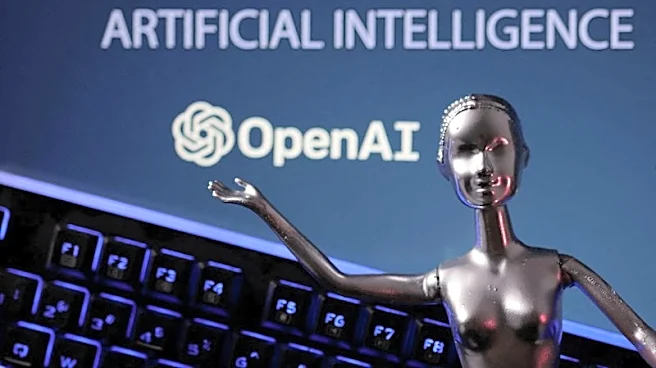
Book authors have filed a motion for summary judgment in a New York federal court, accusing OpenAI of building its ChatGPT models on 'mass piracy.' The motion alleges that OpenAI downloaded books from LibGen, a notorious pirate library, and then took
steps to conceal this activity by renaming datasets. Specifically, book compilations previously labeled 'Libgen1' and 'Libgen2' were relabeled as 'Books1' and 'Books2' in a paper introducing GPT-3. The authors claim that OpenAI employees were aware they sourced books from an illegal site and later deleted these LibGen files in the summer of 2022 due to legal concerns, making them the only two training corpuses OpenAI has ever deleted. The filing covers 194 titles and seeks a ruling that OpenAI copied their work without permission, arguing this cannot qualify as fair use. The authors contend that OpenAI's actions pose an 'existential threat' to writers and publishers, with AI-generated books already saturating the market.
Why It's Important?
This lawsuit carries significant implications for the future of artificial intelligence development, intellectual property rights, and the creative industries in the U.S. If the court rules in favor of the authors, it could establish a precedent that severely restricts how AI companies can train their models, potentially requiring them to license copyrighted material. This would impact the business models of major AI developers like OpenAI and Microsoft, potentially increasing their operational costs and slowing down innovation. For authors and publishers, a favorable ruling could provide much-needed protection against unauthorized use of their work and ensure they are compensated when their content is used to train AI. Conversely, a ruling for OpenAI could embolden AI companies to continue using publicly available data, including copyrighted material, under the umbrella of fair use, further challenging the economic viability of human creators. The case also highlights the ongoing tension between technological advancement and existing legal frameworks, particularly in the rapidly evolving field of AI.
What's Next?
The New York federal judge, Sidney Stein, will now consider the authors' motion for summary judgment, which seeks a ruling that OpenAI's actions constitute copyright infringement and do not qualify as fair use. OpenAI has filed a cross-motion for summary judgment, arguing that its use of the books was fair use and that any regurgitation of copyrighted material is rare. The court's decision on these motions will be a critical next step, potentially leading to a trial if summary judgment is not granted to either party. The outcome could influence other ongoing lawsuits against AI companies, including those filed by The New York Times, Daily News, and the Center for Investigative Reporting, which have also submitted combined summary judgment motions against OpenAI and Microsoft. The legal battle is expected to be protracted, with significant financial stakes and the future of AI training hanging in the balance. Stakeholders, including authors, publishers, and tech companies, will closely monitor these proceedings for guidance on copyright law in the age of AI.
Beyond the Headlines
This case delves into the ethical and economic dimensions of AI's impact on human creativity. The authors' claim that OpenAI's models are designed to 'supplant human writers' is underscored by internal communications, such as a tweet from OpenAI employee Tarun Gogineni, who suggested AI could 'autocomplete' George R.R. Martin's 'A Song of Ice and Fire' series if the author 'dies early.' This raises profound questions about the value of human authorship, the potential for AI to displace creative professionals, and the moral responsibilities of AI developers. The alleged concealment of data sources also brings to light issues of transparency and accountability in AI development. If AI models are built on unacknowledged or illegally obtained data, it could undermine public trust and lead to a 'black box' problem where the origins and biases of AI outputs are obscured. The legal battle is not just about copyright infringement but also about defining the boundaries of acceptable innovation and ensuring a fair ecosystem for creators in the digital age.