


What's Happening?
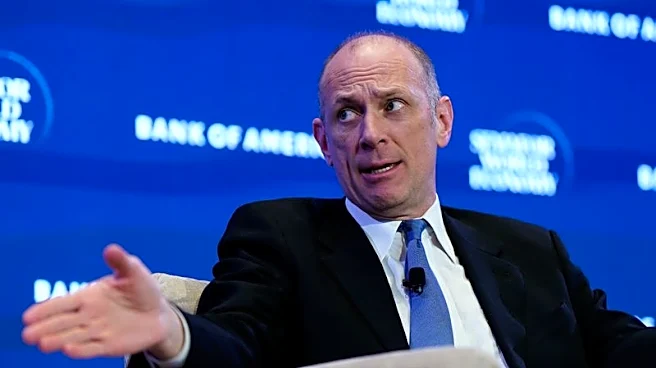
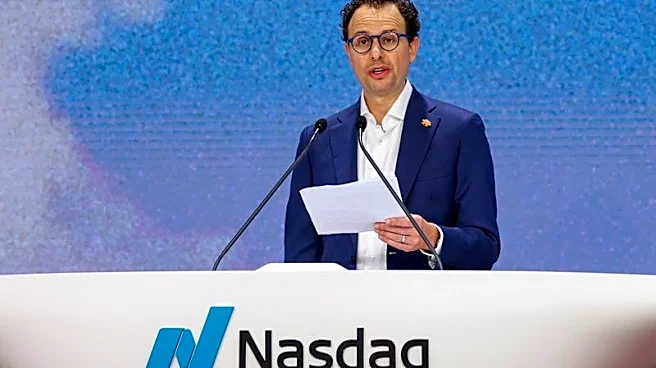
Economist Kevin Warsh has posited that the increasing automation capabilities of artificial intelligence (AI) will lead to a decline in the prices of market goods. His argument suggests that if production can be significantly automated by AI, the cost
of goods will naturally decrease. However, Warsh's peers disagree, pointing to current market trends where prices remain elevated despite a surge in AI integration across various sectors. The core of the disagreement, as highlighted by the analysis, stems from a fundamental misunderstanding of economic terms. Both Warsh and his critics are conflating 'rising prices' with 'inflation' and 'falling prices' with 'deflation.' The article clarifies that inflation is defined as a shrinkage of the monetary unit, while deflation is an increase in its measure, distinguishing these concepts from mere price fluctuations of goods and services.
Why It's Important?
This debate is crucial for understanding the potential economic impacts of AI and for accurate economic forecasting and policy-making. Misinterpreting the difference between price changes and inflation can lead to flawed economic models and misguided strategies. If policymakers and businesses incorrectly attribute price movements solely to AI's influence without considering monetary factors, they might implement ineffective or even detrimental economic policies. For instance, if prices fall due to increased AI-driven production efficiency, it could be a positive development for consumers, increasing their purchasing power. However, if a general decline in the monetary unit's value (inflation) is misidentified as mere rising prices, it could obscure the true economic challenges and necessitate different monetary interventions. This distinction is vital for investors, businesses, and consumers to make informed decisions regarding future economic trends and personal financial planning.
Beyond the Headlines
The discussion surrounding Kevin Warsh's views and his critics' responses reveals a deeper challenge in economic discourse: the precise application of terminology. The article emphasizes that a rising price for one good often occurs alongside falling prices for others, reflecting basic economic tradeoffs. When consumers pay more for a specific item, they inherently have less to spend on other market goods, leading to logical price adjustments across the economy. This perspective suggests that the 'price level' is always in balance due to these inherent tradeoffs. The long-term implications of AI on the nature of work and retirement are also touched upon, suggesting that AI could lead to higher quality work and lower prices, potentially redefining the urgency of saving for retirement. This shift could have profound societal impacts, altering traditional views on career longevity and financial planning.