








What's Happening?
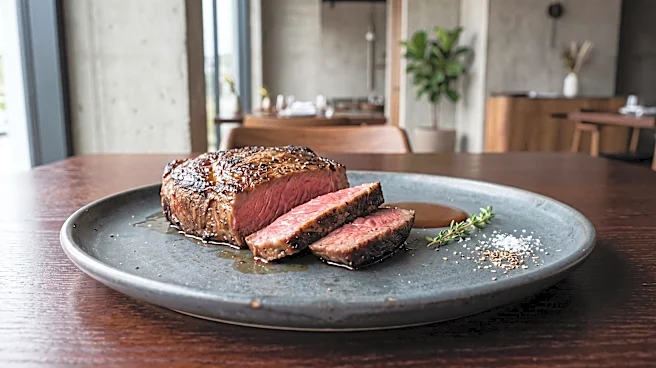
Aleph Farms, an Israeli company, has achieved a significant milestone by receiving regulatory approval from the Singapore Food Agency for its cultivated beef steak. This marks the second regulatory approval for Aleph Farms, following Israel's approval at the end
of 2023, making it the only company currently authorized to sell cultivated beef in two markets. The company plans to launch its cultivated steak in Singapore during the first half of 2027, initially targeting selected restaurants. This development comes after years of research and development, including the unveiling of a cultivated beef steak in 2018 and a 3D bioprinted ribeye prototype in 2021. Despite earlier challenges with cost, large-scale production, and a postponed commercial launch in Israel, this approval signals a step forward for the cultivated meat industry.
Why It's Important?
This approval in Singapore is important for the cultivated meat industry as it represents a crucial step towards commercial viability and global market penetration. Singapore has consistently been at the forefront of regulating and adopting novel food technologies, and its approval provides a significant validation for Aleph Farms' product. For the U.S. market, while this specific approval is international, it demonstrates the potential for cultivated meat to gain regulatory acceptance in advanced economies, which could influence future regulatory decisions and consumer perceptions in the United States. The ability to produce real beef with less reliance on traditional livestock farming could offer benefits in terms of land use, resource consumption, and local food security, particularly in countries that heavily depend on imported meat. This progress could also spur further investment and innovation in the U.S. cultivated meat sector, even as it faces regulatory hurdles in some states.
What's Next?
Aleph Farms is preparing for its commercial launch in Singapore in the first half of 2027, starting with selected restaurants. Concurrently, the company is working towards a launch in Israel and pursuing regulatory processes in additional international markets. The success of these initial launches will be critical in demonstrating consumer acceptance and the scalability of cultivated meat production. The company will need to address ongoing challenges related to cost reduction, large-scale manufacturing, and building out the necessary infrastructure. The experience gained from these early market entries will provide valuable insights for the broader cultivated meat industry, potentially influencing regulatory approaches and market strategies in the U.S. and other regions. Continued research into product characteristics and consumer preferences will also be essential for long-term success.
Beyond the Headlines
The advancement of cultivated meat, as exemplified by Aleph Farms' approval in Singapore, carries deeper implications for global food systems and sustainability. It challenges traditional notions of meat production and consumption, potentially offering a more environmentally friendly alternative to conventional animal agriculture. The technology's ability to create meat without raising and slaughtering animals raises ethical considerations regarding animal welfare and the definition of 'meat.' From a legal and regulatory perspective, the varying approaches taken by different countries (e.g., Singapore's approval versus Florida's ban) highlight the complex and evolving landscape for novel food products. Culturally, the acceptance of cultivated meat will depend on overcoming consumer skepticism and integrating these products into existing culinary traditions. This development could also lead to shifts in agricultural economies, with potential impacts on livestock farmers and related industries, prompting a broader discussion about the future of food security and innovation.